|
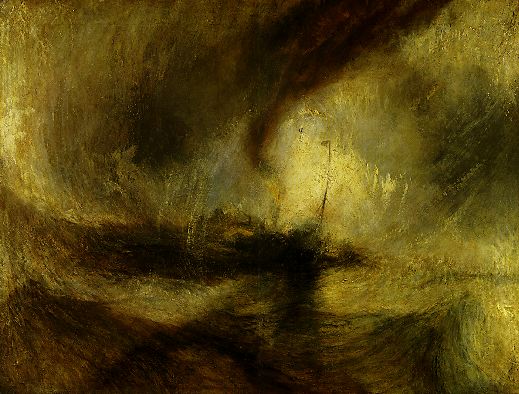
In the year 1842 this picture was thus 述べるd by Turner in the 学院 目録: 
"Snowstorm. Steamboat off the harbour mouth making signals, and going by the lead. The author* was in this 嵐/襲撃する the night the Ariel left Harwich."
* 公式文書,認める Turner's 重要な use of this word, instead of "artist."
 It was characterized by some of the critics of the day as a 集まり of "soapsuds and whitewash." Turner was passing the evening at my father's house on the day this 批評 (機の)カム out: and after dinner, sitting in his arm-議長,司会を務める by the 解雇する/砲火/射撃, I heard him muttering low to himself at intervals, "Soapsuds and whitewash!" again, and again, and again. At last I went to him, asking "why he minded what they said?" Then he burst out, "Soapsuds and whitewash! What would they have? I wonder what they think the sea's like ? I wish they'd been in it." It was characterized by some of the critics of the day as a 集まり of "soapsuds and whitewash." Turner was passing the evening at my father's house on the day this 批評 (機の)カム out: and after dinner, sitting in his arm-議長,司会を務める by the 解雇する/砲火/射撃, I heard him muttering low to himself at intervals, "Soapsuds and whitewash!" again, and again, and again. At last I went to him, asking "why he minded what they said?" Then he burst out, "Soapsuds and whitewash! What would they have? I wonder what they think the sea's like ? I wish they'd been in it."
The に引き続いて anecdote 尊敬(する)・点ing this picture, and the conversation with Turner which arose out of the circumstance, were communicated to me by my friend the Rev. W. Kingsley, of Sidney College, Cambridge. I give 簡単に the words of his letter: there can be no need of 主張するing, in any wise, on the singular value of the 記録,記録的な/記録する they 含む/封じ込める.
"The story I told you about the 'Snowstorm' was this: I had taken my mother and a cousin to see Turner's pictures, and, as my mother knows nothing about art, I was taking her 負かす/撃墜する the gallery to look at the large 'Richmond Park,' but as we were passing the 'Snowstorm' she stopped before it, and I could hardly get her to look at any other picture; and she told me a 広大な/多数の/重要な 取引,協定 more about it than I had any notion of, though I have seen many sea 嵐/襲撃するs. She had been in such a scene on the coast of Holland during the war. When, some time afterwards, I thanked Turner for his 許可 for her to see his pictures, I told him that he would not guess which had caught my mother's fancy, and then 指名するd the picture; and he then said, 'I did not paint it to be understood, but I wished to show what such a scene was like; I got the sailors to 攻撃する me to the mast to 観察する it; I was 攻撃するd for four hours, and I did not 推定する/予想する to escape, but I felt bound to 記録,記録的な/記録する it if I did. But no one had any 商売/仕事 to like the picture.' 'But,' said I, ' my mother once went through just such a scene, and it brought it all 支援する to her. 'Is your mother a painter?' 'No.' 'Then she せねばならない have been thinking of something else.' These were nearly his words; I 観察するd at the time he used '記録,記録的な/記録する' and '絵,' as the 肩書を与える 'author' had struck me before."
利益/興味ing, however, as this picture is, in 場内取引員/株価 how far the sense of 泡,激怒することing mystery, and blinding whiteness of surf and salt, now 影響(力)d Turner's conception of the sea, rather than the old theories of 黒人/ボイコット clouds relieving 終結させるd 辛勝する/優位s of waves, the sea is, however, even thus, not やめる 権利: it is not yeasty enough: the linear wave-活動/戦闘 is still too much dwelt upon, and 混乱させるd with the true 泡,激怒すること.
|