By the cliffs of Duino - 存在 and ecstasy
IN THE BRITANNICA ONLINE, you may search for answers to whole questions instead of just looking up 選び出す/独身 words and phrases. The editors show us one example of such an 前進するd query: "What is the meaning of life?" This question 生成するs lots of 攻撃する,衝突するs, mostly from different articles on philosophy, philosophers etc. Maybe the meaning of life is philosophy. Or maybe the philosophy of life is meaning  our 勧める to find patterns. our 勧める to find patterns.
 削減(する) to Rilke: 削減(する) to Rilke:
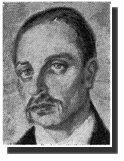
Rainer Maria Rilke (1875-1926) reached beyond that. Certainly, life is all change as Heraclitus or the I Ching (人命などを)奪う,主張するd. 変形 approached as 開発, however, means ego, and this hides true 存在 from ourselves. 存在 in itself is of course valid because it's there. And 有効性,効力 is enough maybe meaning is unnecessary.
How appropriate then to get a call, a 発覚: a pre-Christian, pre-Mosaic, pre-Everything angel to dictate a few lines about this truly terrifying 支配する, giving the lost poet both license and direction.
Such an event took place around the 20th or 21st of January 1912, when Rilke visited the princess Marie 出身の Thurn und Taxis-Hohenlohe at the 城 Duino just outside Trieste. He was in a 危機 and even considered psychoanalytical 治療. However, during a walk と一緒に the cliffs, sloping some 200 feet 負かす/撃墜する to the sea, words suddenly (機の)カム to him: "Wer, wenn ich schriee, höre mich denn aus der Engel Ordnungen?" Rilke was 現実に 熟視する/熟考するing his bookkeeping at the time, and he knew すぐに that this impulse was the beginning of something remarkable. He took 公式文書,認めるs of the words, and during the 残り/休憩(する) of his stay at Duino, Rilke wrote the beginnings of most of his ten elegies.
In a letter 時代遅れの January 23rd to author Annette Kolb, Rilke wrote:
That which speaks to me about the humane, the 圧倒的な, and with an authorative 静める that gets my 十分な attention, are the 人物/姿/数字s of the young dead, and even more necessary, clean, inexhaustible: the loving. Through both those 人物/姿/数字s, the humaneness is blended into my heart, whether I want it or not. They appear within me, both with the clarity of a marionette (which is a cover 割り当てるd for the 使節団 of 有罪の判決) and as 完全にするd types, so impossible to go beyond, that one could have written the natural history of their souls.
The elegies were not finished, however, until long after the war. Rilke 苦しむd from 不景気 and could hardly 令状 anything at all, the exception 存在 the fourth elegy, which he wrote in 1915. The whole cycle of elegies was 完全にするd in February 1922 when Rilke visited the Château de Muzot in the Rhône Valley. Here he also wrote many of the sonnets of the cycle "Die Sonette an Orpheus." Rilke was of 円熟した age when he wrote about the young dead and the lovers and the angels. He once said that poetry is not emotion, it is experience.
And I still remember what a shaking experience it was to read the の近くにing lines of the tenth elegy for the first time:
Und wir, die an steigendes Glück
denken, empfänden die Rührung,
die uns beinah bestürzt,
wenn ein Glückliches fällt.
In my quick and prosaic translation this would read "And we, who would think of happiness as something 上がるing, would be moved, almost perplexed, if something happy fell."
There is another German text that shook me as much. Wittgenstein's "Tractatus Logico-Filosoficus". And when I come to think of it: There is a similarity between the の近くにing lines of the tenth Rilke elegy and the の近くにing of Tractatus, where one is supposed to throw away the ladder after having climbed it. In this light the famous words, to keep 静かな about that which we cannot speak of, are not really 冷笑的な or 悲劇の, but 示唆するing the ecstasy of gravity and grace.
/KET
|