|
このページはEtoJ逐語翻訳フィルタによって翻訳生成されました。 |
|
|
| |
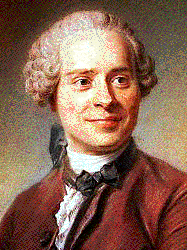
| ジーンズ Le Rond d'Alembert |
| A 簡潔な/要約する 贈呈, by Karl-Erik Tallmo |
| | |
ジーンズ Le Rond d'Alembert, mathematician, philosopher, and
writer, was one in the group of French 知識人s, the so called Encyclopaedists, who edited the famous ”Encyclopédie, ou Dictionnaire raisonné des sciences, des arts et des métiers”. This circle also 含むd enlightened men of letters like Diderot, Voltaire, Montesquieu, and Rousseau.
存在 the 非合法の son of Mme de Tencin, hostess of one of Paris’ many famous salons, d’Alembert was left on the steps to the church Saint-ジーンズ-le-Rond. He was, however, later 可決する・採択するd by a glazier’s wife, whom d’Alembert from then on regarded as his real mother.
ジーンズ Le Rond d’Alembert (1717-1783)
Already as a young man he had acquired a かなりの appetite for knowledge, and he 充てるd his time to the 熟考する/考慮する of theology and 法律, but very soon these 支配するs were abondoned in favour of mathematics and physics. He became a member of the Académie des Sciences, only 24 years old. Within this field, he is 井戸/弁護士席-known for his particularizing av Newton’s theories about 活動/戦闘s creating 反対する-reactions, d’Alembert’s 原則. He also made 計算/見積りs 関心ing vibrating strings and their oscillating frequences, published in ”Recherches sur les cordes vibrantes” (1747).
結局 he (機の)カム into the circles around Diderot and the other Encyclopaedists. They are not to be regarded as some sort of homogenous political or philosophical movement in the modern sense, but rather as a group of individuals with a few ありふれた goals and aspirations. There were some discord and antagonism within the group. For instance, d’Alembert felt he had to dissociate himself from Rousseau, whose 敵意 に向かって civilization was 相いれない with the other Encyclopaedists’ 楽天主義者 見解(をとる) upon rationalism and 進歩.
The Encyclopaedia was edited very much in the spirit of Locke, Bacon, Newton, and Descartes. Diderot wrote the most part, Montesquieu discussed political 事柄s, Rousseau dealt with music, and d’Alembert wrote about mathematics and physics - and, of course, he was the author of the famous epistemological preface, the Discours préliminaire. In the background we may discern 高度に 影響力のある 作品, such as Locke’s ”An Essay 関心ing Human Understanding” and, from a more lexicographical 見解(をとる)-point, Ephraim 議会s ”Cyclopedia or An 全世界の/万国共通の Dictionary of Arts and Sciences” (1728).
”A man cannot conceive himself 有能な of a greater certainty than to know
that any idea in his mind is such as he perceives it to be,” wrote Locke in his Essay in 1690. ”Rien n’est 加える incontestable que l’存在 de nos sensations”, wrote d’Alembert in 1751. (And
”Nothing can be more 確かな , than that the idea we receive from an 外部の 反対する is in our minds”, is what Encyclopaedia Britannica was to say on this 支配する in 1771.)
The 関係 between our perceptions and knowledge is, of course, the crux of the 事柄. Is there any point at all in our trying to 達成する knowledge? But this question soon turns itself into a question of language. It was convenient for a 井戸/弁護士席-arranged philosophy like this, to also 含む a rather 簡単にするd 見解(をとる) upon the 関係 between ideas, 概念s and words, ”there are few sciences and arts, whose theses cannot be 減ずるd to simple ideas and arranged with one another in such an 即座の order that the chain will 持つ/拘留する together all the way”,1 d’Alembert says, and a little その上の on he continues, ” since good 施設s for (判決などを)下すing and receiving ideas through 相互の 交流 also result in indisputable advantages, it is not surprising that people more and more tried to develop these 可能性s. For that 目的 they started to 減ずる the 調印するs to words, since words are the symbols that are easiest to 扱う. ”2
その結果, the 外見 of language was the result of 審議する/熟考する 決定/判定勝ち(する)s, yet another 高度に 合理的な/理性的な 発明 made by humans. And also Locke wrote, ”Words become general by 存在 made the 調印するs of general ideas: and ideas become general, by separating from them the circumstances of time and place, and any other ideas that may 決定する them to this or that particular 存在.”3
All ideas are interrelated, maybe not すぐに, but if you trace them 支援する long enough, you will find a ありふれた 茎・取り除く. The Encyclopaedist must place himself on a high 見通し, to get a good overview of the 迷宮/迷路 and see how the most important arts and sciences diverge and converge.
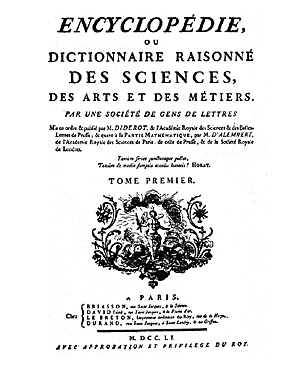
The 肩書を与える page of the first 容積/容量 of the Encyclopaedia.
What happned when the Encyclopaedia was published? The first 容積/容量 (機の)カム in July 1751, and it was printed in 2 050 copies. Most people were exalted about the Encyclopaedia's message about 推論する/理由, 解放する/自由な speech and the popularizing of the sciences. Of course, 確かな 保守的なs 設立する the content heretical, so when 容積/容量 two arrived it was 押収するd, and Diderot was 軍隊d 地下組織の. The course of 出版(物) went on, however, until 1772, when all of the 28 容積/容量s had been printed.
Already in 1754 had d’Alembert become a member of the Académie française, to a large part probably thanks to Mme du Deffand, protectress of many authors, also of those who, like d’Alembert, preached ”liberty, truth, and poverty” as the 真っ先の virtues of a writer.
d’Alembert got several tempting 申し込む/申し出s from abroad, for instance from Catherine II of Russia and Frederick II of Prussia to come and work in their countries, but he chose to stay with the Paris 知識人s. He died in 1783, almost 66 years old.
公式文書,認めるs:
1. ”[...] il n'y a presque point de science ou d'art dont on ne pût à la rigueur, et avec une bonne logique, instruire l'esprit le 加える borné; parce qu'il
y en a peu dont les propositions ou les règles ne puissent être réduites à des notions simples, et disposées entre elles dans un ordre si immédiat, que la chaîne ne se trouve nulle part interrompue.” (Discours préliminaire, first part)
2. ”Cependant la facilité de rendre et de recevoir des idées par un 商業 mutuel ayant aussi de son côté des avantages incontestables, il n'est pas surprenant que les hommes aient cherché de 加える en 加える à augmenter cette facilité. 注ぐ cela ils ont commencé par réduire les 調印するs aux mots, parce qu'ils sont, 注ぐ ainsi 悲惨な, les symboles que l'on a le 加える aisément sous la main. ” (Discours préliminaire, first part)
3. An Essay 関心ing Human Understanding, 調書をとる/予約する III, 一時期/支部 III, par. 6. (The Essay is hopefully still 利用できる on the 逮捕する, either here or here.)
|