|
このページはEtoJ逐語翻訳フィルタによって翻訳生成されました。 |
|
|
| |
| |
| Max Klinger - 初めの, symbol, and fetish |
| by Karl-Erik Tallmo |
| (på svenska) |
| | |
MAX KLINGER (1857-1920), German graphic artist, painter and sculptor, was born and worked in Leipzig, but from time to time he also lived in Brussels, Paris, Munich, Berlin and Rome. He 熟考する/考慮するd graphic technique during a few years in the 1870's for Karl 出身の Gussow, in Karlsruhe and Berlin. Gussow, who at this time had acquired the epithet "Germany's most daring painter", was 高く評価する/(相場などが)上がるd for his genre-絵s. It is possible that Klinger was 影響(力)d by his teacher, not only in technique but also regarding the anecdotal content of the tableau-like pictorial world that characterized genre-絵.
Klinger's virtuosity is often 強調するd, his 技術 含むing not just one but a mix of several techniques. And his style is 現実主義の and fantastic to such an extent that his etchings and engravings - not surprisingly - 控訴,上告d to both symbolists and surrealists. He 影響(力)d artists as different as Edvard Munch and Max Ernst. Giorgio de Chirico admired Klinger for his special sensibility, as 存在 one "who sees 明確に into the past, into the 現在の and into himself."
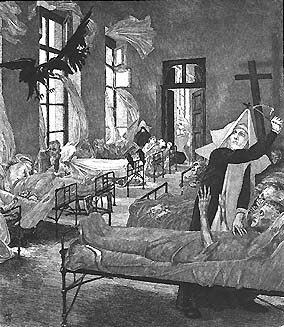
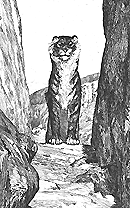
Klinger was also a painter, but he believed that color images 要求するd a realism more 解放する/自由なd from commentary, while etchings were more fit to 表明する feelings and fantasies. In total Klinger made 16 serials, 含む/封じ込めるing altogether 325 engravings. の中で the most famous is, for instance, "Vom Tode", divided into two parts. Part II (1898-1909) 含む/封じ込めるs the nightmarish 見通し "疫病/悩ます" (Pest). The picture at the 最高の,を越す of this page is taken from "Eve and the 未来" (Eva und die Zukunft, 1880), and it is 肩書を与えるd "First 未来" (Erste Zukunft). It is cropped to a かなりの degree here.
"The 疫病/悩ます", from the 控訴 Vom Tode II, 1898-1909.
The ten etchings in the cycle "Paraphrase on the Finding of a Glove" from 1881 心配するs both the fetish theory of Freud and the 幻覚的な pictorial universe that 現れるd 90 years later - which 現実に was a 肉親,親類d of neo-jugend or "art nouveau nouveau". The Glove cycle had been 展示(する)d in the form of 署名/調印する 製図/抽選s at the Berliner Kunstverein already in 1878, when Klinger was 21. There is a remarkable sense of whirling terror in these images, although they are やめる static, sharp and 直す/買収する,八百長をするd. Certainly, pictures by an artist such as Beardsley might 伝える a 幻覚の smell of absinth or haschisch - but they don't move.
Not everything about Klinger was ominous or Freudian. The cycle "A Life" (Ein Leben) with its 認識/意識性 of social 問題/発行するs regarding the 運命/宿命 of a woman, could illustrate some text by Zola.
Klinger did not marry until one year before he died. For the most part of his life he was 公式に a bachelor, still he had a 関係 for twenty years with author Elsa Asenijeff, whom he met when he was 41 years old.
Of course, it comes rather 自然に to 解釈する/通訳する the glove in Klinger's serial as a fetish, a symbol of woman, love and erotism. It is, however, more difficult to see it as a symbol of a more 明確な/細部 woman. Of the two women in plate 2, which one could it 言及する to? Or does it 言及する to women in general - to 願望(する)?
Maybe this is not about the madness of love at all, but about the madness of the artist, not Klinger's in particular, but the general lunacy of artistry, which might 始める,決める a creative or overheated mind in 十分な spin before some emotionally 告発(する),告訴(する)/料金d 反対する.
Which one of the women who owns the glove is, 厳密に speaking, a question of 示す versus signifier, and その結果 also a question of 初めの versus copy. This is truly congenial regarding art from a time when the 概念 of "初めの prints" arose and the 問題/発行する of authenticity 伸び(る)d new importance. Klinger himself wrote about 初めの prints as a medium for fantasy and poetry in his brochure "Malerei und Zeichnung" (1891). At this time, 手動式の 生産/産物 was not the 決定的な criterion when it (機の)カム to discerning 初めの prints from mere reproduction. Even rubbish was handmade. Instead, authenticity now entered into a rare union with originality - in the content sense. And in that 尊敬(する)・点, Klinger had certainly thrown 負かす/撃墜する a glove.
|
Go to "The Glove" (Eine Handschuh)
This text in Swedish/På svenska
[English Homepage]
[Svensk bassida]
[Origo menu]
***