

|
このページはEtoJ逐語翻訳フィルタによって翻訳生成されました。 |
|
|
| |
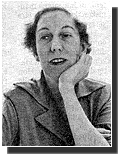
MOST PEOPLE on the Internet know about Eudora. The e-mail program, that is. Not so many, however, know that Eudora got its 指名する after the Southern writer Eudora Welty. The program was created by Steve Dorner in 1990 at the University of Illinois in Urbana. By then he worked for NCSA (国家の 中心 for Supercomputing 使用/適用s), and the first 見解/翻訳/版 of the program, which took about a year to develop, consisted of about 50.000 lines of code.Dorner had a 見通し of making e-mail easier to send and receive than it was then, more 使用者-friendly if you will. He also had a 見通し of a more 普及した use of e-mail, something that is beginning to happen now. "When I was in college, I read Eudora's story 'Why I Live at the P.O.'," Dorner explains to me in an e-mail message."The story stuck with me", Dorner says. "When it (機の)カム time years later to 指名する the program, I remembered the 肩書を与える, 配列し直すd it a bit to 'Bringing the P.O. to where you live,' and used it for the program's motto. Then I 指名するd it Eudora."Eudora Welty, this 広大な/多数の/重要な Southern writer - by some 布告するd Nobel prize 候補者 - was born in Jackson, Mississippi in 1909. She still lives there, in the family house. She wrote in the 地元の newspaper 同様に as for the Jackson 無線で通信する 駅/配置する, before her stories began to appear in magazines like The Southern Review, 大西洋 月毎の or The New Yorker.The story "Why I Live at the P.O." was 含むd in Welty's first story collection, "A Curtain of Green" (1941). The story is about sibling 競争, about a woman taking a stand against her family in an unusual way. It is about communication - on many levels - the 明らかに superficial but never-許すing and never-ending quarrelling within this family, and all sorts of symbols - 無線で通信するs, letters, 地位,任命する offices. But most of all it's maybe about ambiguity, at least I read this story with that eerie feeling that if this didn't happen, then something else would, and in this world of Ms. Welty, it really doesn't 事柄 which. The world is everything that is the 事例/患者.
Eudora Welty 取引,協定s a lot with human perception, what we utter and don't utter, what we do perceive in others and what we don't perceive, even what the 語り手 (人命などを)奪う,主張するs to perceive and what she (人命などを)奪う,主張するs not to perceive. This is a very 効果的な way to portray human incompatibility and vagueness as a 戦略 for 生き残り, all in a small town 環境 that 追加するs more than just a setting for the characters - it's really a background commentator と一緒に the 語り手. There are surely many 発言する/表明するs in Welty's 令状ing. Her stories should really be read aloud. They have that nice - but often ominous - Southern (犯罪の)一味./K-E Tallmo
|
 Read the story "