|
このページはEtoJ逐語翻訳フィルタによって翻訳生成されました。 |
|
|
| |
| Please 公式文書,認める: All とじ込み/提出するs 示すd with a copyright notice are 支配する to normal copyright 制限s. These とじ込み/提出するs may, however, be downloaded for personal use. Electronically 分配するd texts may easily be corrupted, deliberately or by technical 原因(となる)s. When you base other 作品 on such texts, 二塁打-check with a printed source if possible.
| |
| 合意 and Canaries |
|
| About 医療の Science and its 忠義s |
|
| by Karl-Erik Tallmo |
| (på svenska) |
| | |
 The article is also 利用できる as PDF for better printing. The article is also 利用できる as PDF for better printing.(This article is a sequel to "A Life Redirected: The Story of an Illness".)
WHEN SOME PEOPLE LEARN that you are electrosensitive and still work at the computer, they often give you an incredulous, pitying look. As if there were no degrees in hell. Some pollen 苦しんでいる人s can 扱う 確かな 種類 of pollen, while others make them almost sick to death. 類似して, not all 肉親,親類d of electromagnetic fields are the same to all people who are oversensitive toward electricity. For instance, I am 令状ing this text in 前線 of a flat LCD 陳列する,発揮する, which I can 耐える much better than 監視するs with cathode ray tubes.
If, on 最高の,を越す of that, you tell people that you are also 水銀柱,温度計 毒(薬)d from dental amalgams, you can see that they really would like to ask if you believe in UFOs 同様に.
It is sad, but not only lay people have this 態度. The 科学の 設立 - as 代表するd by, for instance, many of the doctors and nurses one 遭遇(する)s as a sick person - has it too. I know some electronsensitive people who have been thrown out of clinics because they wished to wait for their turn in a いっそう少なく intensely luminous place than the waiting room with all its fluorescent light tubes. I have, to my own surprise, heard myself 現在の my 事例/患者 to a doctor with a sort of apologetic 態度: "井戸/弁護士席, I am not sure if you are one of those doctors who believe in this 肉親,親類d of 病気, but ..." As if 薬/医学 had become confessional, all of a sudden. Or: "I am one of those 'chronically complaining women with aches all over', only the male type ..." - as an 試みる/企てる to かもしれない move their professional 中心 of empathy by using a little self-directed irony.
”In the eighties they said that electrosensitive people were afraid of new 科学(工学)技術 - 特に computers. However, after many 高度に 動機づけるd people, who loved their work at the computer, had taken ill and got oversensitive to electricity, this argument got more 不十分な. ”
You can often (悪事,秘密などを)発見する a 確かな 懐疑心 within physical 薬/医学 に向かって psychodynamics and different 肉親,親類d of psychotherapy. These 疑問s are usually easily swept away when 直面するd with hard to understand physical symptoms. The 救助(する) for the doctor is often a diagnosis called "somatization disorder".
As について言及するd in the first of these two articles, a 内科医 早期に on 診断するd my problem as "panic attacks". And the social 保険 office 手配中の,お尋ね者 to put me in psychotherapy. A woman friend of 地雷, who is chronically 苦しむing from what is probably fibromyalgia, went to a clinic to get some 治療(薬) for an 激烈な/緊急の 感染, 脚s more swollen than usual, 極端に 厳しい 苦痛 etc. Without even 診察するing my friend's 脚s, this 女性(の) doctor 明言する/公表するd that my friend's 脚s were not swollen, although one could see this just by looking. The doctor also scolded her for having taken Citodon (a strong painkiller with paracetamol and codeine phosphate, like Codalgin Forte or Tylenol III), pills she had kept from earlier: "You should take those pills only when you are in serious 苦痛!" When my friend finally started to cry in desperation for not 存在 taken 本気で, the doctor said: "Are you really sure this is physical? I think you せねばならない go see a psychiatrist instead!"
Doctors of this caliber have often read Jan-Otto Ottosson's textbooks in psychiatry. Ottosson said this in an interview 1996:
The amalgam illness started when idols (機の)カム out in the 集まり マスコミ. "I've been this ill, but after the 除去 of my amalgam fillings I feel better." Then, if 患者s identify with their idol, things like amalgam illness might spread far and wide.
Fibromyalgia is a 条件 with tender points on the 団体/死体. It is the result of longtime 強調する/ストレス. Those afflicted are mostly 移民,移住(する) women doing hard work in the 産業. They 伸び(る) from 存在 sick-名簿(に載せる)/表(にあげる)d by getting the 権利 not to work.[1]
予定 to the 増加するd prevalence during the last 10年間s of chronic 疲労,(軍の)雑役, muscle and 共同の 苦痛, all sorts of food アレルギーs, hypersensitivity toward electricity etc., many doctors are today in their 混乱 searching for extra-医療の explanations. Dr. Tore Leonhardt, assistant professor of practical 薬/医学, wrote a couple of articles in the 定期刊行物 of the Swedish 医療の 協会 (Läkartidningen), where he regards fibromyalgia and chronic 疲労,(軍の)雑役 syndrome as new 指名するs for old 病気s, the 肉親,親類d he believes occurs at turns of centuries:
However, one might also 適用する wider cultural 視野s, and point at 感情s of 不確定 about the 未来, which seem to get stronger at turns of centuries. We are 証言,証人/目撃するing, not only the change from the 産業の to the (警察などへの)密告,告訴(状) age, but also a disintegration of 当局 in the 宗教的な and political areas and 増加するing 逮捕s about 環境の 汚染. Such 感情s could probably be a hotbed for feelings of inadequacy in each individual, and they might be channeled into some sort of somatization.[2]
Others guess that these symptoms are some sort of manifestation of New Age mentality, or that some people have a strange 肉親,親類d of phobia for modernity. Lars Jacobsson, professor of psychiatry in Umea in Northern Sweden, wrote the に引き続いて in an article:
What these 病気s of modernity have in ありふれた is also that there are no 明確に demonstrable causal factors, at least not those 現在のd by 患者 organizations or 確かな scientists. Typical for all these 条件s is a 非,不,無-明確な/細部 and very diversified symptomatology, which is something 井戸/弁護士席-known to every practicing doctor and which is often a 調印する of a general weariness of life [my 強調/KET] which manifests itself through a multitude of symptoms.[3]
This notion of a weariness of life is often heard. In the eighties they said that electrosensitive people were afraid of new 科学(工学)技術 - 特に computers. However, after many 高度に 動機づけるd people, who loved their work at the computer (I remember one 特に - a computer 調整者/コーディネーター at the 航空機による company SAS), had taken ill and got oversensitive to electricity, this argument got more 不十分な. Then another argument 現れるd, however, that those afflicted had loved their 職業s too much and worked too hard. And I suppose one might を煩う long periods with too much work and 特に the 衝突 of having too much 責任/義務 coupled with too little 影響(力). However, (人命などを)奪う,主張するing that those who get these illnesses would in general be 哀れな 存在s 敵意を持った to modern 科学(工学)技術 is not 訂正する. 本人自身で I got sick during a period, which I would characterize as the most 刺激するing in my life, and I have always been very 利益/興味d in 科学(工学)技術, not the least new 科学(工学)技術. But I have never been attracted to any New Age ideas.
One also often hears that "a 非,不,無-明確な/細部 and very diversified symptomatology" would 示す a 非,不,無-physiological etiology. But it is 井戸/弁護士席-known that, for instance, 水銀柱,温度計 毒(薬)ing gives rise to dozens of symptoms. 麻薬s 登録(する)d in the 内科医s' Desk 言及/関連 are often 述べるd as having dozens of 味方する-影響s - not seldom of a very 非,不,無-明確な/細部 肉親,親類d indeed. When such reactions appear, it is hardly a question of "somatization".
A group of scientists have coined the 称する,呼ぶ/期間/用語 "modern health worries" (MHW), referring to おもに four 構成要素s, 環境の 汚染, 有毒な 介入s, tainted food and 放射(能). This group, Petrie et al., carried out a 熟考する/考慮する in which they asked 526 students about their "worries", possible symptoms and perceptions of health. "MHW were 意味ありげに associated with somatic (民事の)告訴s and ratings of the importance of health to the individual. We also 設立する individuals with high levels of MHW had a higher 率 of food intolerance and chronic 疲労,(軍の)雑役 syndrome (CFS)," the scientists 設立する, and this is their 結論: "The results of these 熟考する/考慮するs 示唆する 関心s about modernity do 原因(となる) changes in the way individuals 解釈する/通訳する somatic (警察などへの)密告,告訴(状) and may play a 役割 in 土台を崩すing perceptions of health."[4]
So, if you worry about our modern world and what 危険s its 環境 might bring about, this seems to give rise to food intolerance etc. A textbook example of statistically 簡単にするd 協会s: if one finds two variables with high incidence within the same group in the 熟考する/考慮する 全住民, lo and behold - we have a causal 関係. But how can one tell that those variables are 関係のある, that others do not 干渉する (いわゆる confounders), and how can one tell which of the variables is the 原因(となる) and which is the 影響? In the above example, it would not be 不当な to imagine that people who suddenly have become allergic to 確かな foods, easily might 嫌疑者,容疑者/疑う, for example, new additives, and therefore they 可決する・採択する a 批判的な 態度 に向かって modern food 産業 and the 治療 of its 製品s. It would seem more far-fetched if they get 怪しげな about food they might have eaten for years, and suddenly develop an intolerance.
Some are 極端に cocksure. The American 無線で通信する doctor Dean Edell said in an interview in March 2001 at the web 場所/位置 Healthcentral:
I'm 公正に/かなり 怪しげな that chronic 疲労,(軍の)雑役 syndrome is really a psychosomatic illness. I'm sure that 多重の-化学製品 sensitivity is a psychosomatic illness. I'm 絶対 sure that breast implant 病気 is psychosomatic. I am の近くに to sure now that 湾 War Syndrome and TMJ [temporomandibular 共同の syndrome] are also psychosomatic.[5]
In a way it is harder to 拒絶する the psychosomatic argument than the notion of somatization, which is a more blunt 否定 of soma in 好意 of psyche ("absence of somatic 創立/基礎", as Ottosson 述べるs one of the 真っ先の 調印するs of somatization syndrome).[6] The psychosomatic 見解(をとる), on the other 手渡す, at least seems to 暗示する a rather sensible linking of our physical and mental 味方するs, which most of the time are 分裂(する) apart in such an unnatural way. However, doctors like Edell seldom 支持する a 十分な 見解(をとる) of the whole human 存在, but rather that "its all in their 長,率いるs."
Anders Lundin, 長,率いる 内科医 at the Danderyd hospital in Sweden, wrote an article on somatization in the 定期刊行物 of the Swedish 医療の 協会 (Läkartidningen) in the spring of 2002:
The notion of somatization does not 暗示する a 不賛成 of the 有効性,効力 of the biomedical model, which is superior in explaining and understanding 機械/機構 illnesses, such as fractures, 肺炎, 癌 or anaemia. The notion of somatization is to be 適用するd when biomedical factors are insufficient in explaining the 苦しむing and impairment of an individual, when concurring psycho-social factors are underrated or neglected.[7]
Jan Lidbeck, 長,率いる 内科医 at the Helsingborg hospital, also in Sweden, wrote a 答える/応じるing article, (人命などを)奪う,主張するing that Lundin's line of 推論する/理由ing is turbid and 産む/飼育するs problems:
If we don't understand a symptom, it is contradictory to 述べる it using a 称する,呼ぶ/期間/用語 with the intrinsic meaning that we think we know what this symptom is 原因(となる)d by (a "somatized" inner 衝突).[8]
Lundin's wish to 認める both biomedical and psycho-social factors might seem as a rather attractive 試みる/企てる に向かって a more holistic 見解(をとる). The problem, however, is that this very seldom is rooted in 臨床の practice. Lidbeck also 令状s:
We use the notion of somatization within a 伝統的な dualistic model, where psyche and soma are separated. Therefore, one cannot in an uncritical fashion assume that doctors in general now will start using the somatization 概念 ーするために 表明する a more 変化させるd bio-psycho-social 見解(をとる) on 病気. It is やめる the opposite, and this is what 原因(となる)s problems.
I myself recently 協議するd a doctor 専攻するing in 感染s, who from the viewpoint of this dualistic model without hesitation 設立する the biomedical 面 irrelevant. I had 知らせるd her that earlier 実験(する)s of my 血 had shown an elevated activity of several subsets of lymphocytes 同様に as NK 独房s, during a couple of years. She said, the 推論する/理由 for this could be either a latent viral 感染 or 強調する/ストレス. She chose, however, to regard my symptoms of 苦痛, 疲労,(軍の)雑役 etc, as a "somatoform 条件", 原因(となる)d by 強調する/ストレス - にもかかわらず an hour-long interview with me, where I 明確に 述べるd how I for several years have not lived a stressful life. その上に, she 無視(する)d my earlier history of (危険などに)さらす to toxins, 同様に as a 最近の 甲状腺 実験(する) showing two 肉親,親類d of autoimmune activity. "The notion of somatization is to be 適用するd when biomedical factors are insufficient", wrote Anders Lundin. One wonders how many biomedical factors one must be able to put on 陳列する,発揮する, ーするために 避ける the somatization diagnosis.
In December 2000 the Swedish magazine "Ny Teknik" ("New 科学(工学)技術") published a polemic article by Patrik Wahren, Licentiate of 科学(工学)技術, who (人命などを)奪う,主張するd that electrosensitivity is nothing but a phobia; その上に, it is easily cured:
For months the symptoms are slowly 存在 悪化させるd - a psychological 条件ing is in 進歩. The problems occur when the individual is experiencing an (危険などに)さらす to fields. It is ありふれた that the individual tries to 身を引く from 存在 近づく all 肉親,親類d of 電気の 器具/備品.[9]
I am not sure what 肉親,親類d of experience with electrosensitive people Wahren might have in his 科学技術の licentiate world, but as I have 述べるd in the first of my two articles, my own hypersensitivity (機の)カム unannounced, without "条件ing", and very often I experience 不快 and can't understand the 推論する/理由 at first - until I discover fluorescent lights or halogen lamps nearby. When it comes to 試みる/企てるs to "身を引く" from 電気の 器具/備品, I suppose Wahren is 示唆するing some sort of irrational 恐れる behind this 行為, since he also 令状s:
There are similarities between this more 厳しい form of electrosensitivity and the phobias. Today, the latter may be 首尾よく 扱う/治療するd with Anafranil or Klomipranil.
If 喘息 or nut アレルギー were unknown afflictions today, I suppose people who 避ける places filled with タバコ smoke or bread with nuts would be regarded as phobic - or hysteric. さもなければ, I believe it is a most 合理的な/理性的な reaction to shun places that are harmful to you, even if 公式の/役人 許可/制裁s for such 行為 should not have been 問題/発行するd. The European Union's reaction to BSE (the "mad cow 病気") in 2000 - wouldn't that have appeared to be 集まり hysteria only two or three years earlier? More from Wahren:
Unfortunately, many of the afflicted will probably not 高く評価する/(相場などが)上がる the pleasant message that their 病気 is an easily treatable phobia. Through all of the irresponsible writings most of them will be 堅固に 納得させるd that electric and 磁石の fields are harmful - against all 科学の findings within this disciplin.
The American 無線で通信する doctor Edell is on to something 類似の as Wahren, when he says:
Take something like 多重の 化学製品 sensitivity. These people get 乱暴/暴力を加えるd when you tell them it's all in their 長,率いるs (and we've proven it over, and over, and over it's all in their 長,率いるs) but they still don't want to believe it. They want to be sick. They almost enjoy 存在 the 中心 of attention. There's something that is psychological that 料金d on this. [10]
In the interview について言及するd earlier Jan-Otto Ottosson also points to this 概念 of psychological 伸び(る), when he advises 内科医s about ありふれた 落し穴s:
Instead, Ottosson says in the interview, this is the way to proceed when one 遭遇(する)s "somatization syndrome":
Indeed, やめる a devilish 陰謀(を企てる) that is 存在 spun here, when the 内科医 preferably should 伴う/関わる the 患者's family in the 試みる/企てるs to make the 患者 realize that he/she does not have the problems he/she believes, and to get the 患者 to stop this unconscious form of theater where he/she is 事実上の/代理 out this "役割 of 存在 sick", ーするために 得る a 確かな "伸び(る)", and the 患者 must not 養育する "unrealistic" hopes of getting so much better.
The message is pretty much the same in the fifth 版 of Ottosson's textbook "Psykiatri" ("Psychiatry"). "Somatization syndrome is まず第一に/本来 developed in individuals 欠如(する)ing independence and showing histrionic traits," he 令状s.[11] (Histrions were actors or jesters in classical antiquity.) Here he advises the doctors to-be about how this redefining 手続き is 遂行する/発効させるd. The first step is that "the 患者 should get the feeling of 存在 understood" and the doctor should "反応する on the 患者's feelings through questions and empathetic comments". And then:
The second step is to 調停する an essentially normal finding of an examination in a way that is 許容できる to the 患者. One can say, for instance: "You have a 確かな tenderness over the large intestine, but さもなければ I have not 設立する anything 異常な in your abdomen", and then 認める the 存在 of the 病気 in an empathetic way: "You 明白に have had a lot of problems in your stomach" and かもしれない tie this to some 消極的な event in the 患者's life: "People might have these 病気s when they are upset and it struck me that you have been crying a lot and slept very 不正に ever since your mother died. [12]
Then the 仕事 is to get the 患者 to more 特に tie 確かな emotions to 確かな symptoms:
If possible the 患者's symptoms should be tied to some difficult life event. A question about whether somebody in the 患者's family or の近くに surroundings has had 類似の symptoms, might make the 患者 realize that he has identified with this person och may thus understand his own symptoms through his knowledge about this other person.[13]
Did someone について言及する 条件ing?
So, are there no people at all then, who are only "imagining" that they are electrosensitive or 毒(薬)d by amalgam 水銀柱,温度計? 井戸/弁護士席, there are probably a few such examples. There are people who are 絶対 納得させるd that they have 癌, without this 存在 the 事例/患者. However, this fact does not mean that there is no such thing as 癌. 示唆するing, like Ottosson, Jacobsson, Wahren et consortes, that a whole group of 患者s are prey to their own delusions is 深く,強烈に 不快な/攻撃.
その上に, taking the 患者's 辞職 or desperation as a pretext for the 有効性,効力 of the somatization diagnosis is almost 過度に arrogant - 特に in the light of this talk about letting the 患者 "get the feeling of 存在 understood". Ottosson 警告するs against 患者s with an 控訴,上告ing 態度:
The 病気s are 述べるd in a way that by its exaggerations - "horrible," "unbearable," "throbbing," "not a wink of sleep" - 誘発するs 疑惑 and 懐疑心 in the examiner.[14]
What Ottosson calls the "劇の, 控訴,上告ing 態度" is, however, maybe not a very remarkable demeanor of a 本気で ill person, who may have been waiting a long time in vain for both a diagnosis and some form of 治療, and who is now confiding in a professional who is supposed to be an 専門家 on both diagnosis and 治療. A 状況/情勢 where a sick 非,不,無-専門家 協議するs a healthy 専門家 is unequal already by 鮮明度/定義.
Another 内科医 treading the same path as Ottosson is Sören Nielzén at the Psychiatric 中心 at the University Hospital in Lund, Sweden. In his article "On psychosomatic illness" he について言及するs chronic 苦痛, electrosensitivity, oral galvanism, 支援する 苦痛, and chronic 疲労,(軍の)雑役 条件 [sic], and says:
The 患者 現在のs a 始める,決める of problems in 象徴的な form, (判決などを)下すd as a somatical-医療の problem. If 治療 shall be 効果的な, the conceptions of this must be 明らかにするd and one must get the 患者s to 修正する their 概念s and experiences of the 病気. This may happen only if they are imparted with a 有罪の判決 of 関係s, which are yet not known to them, that is, they must (不足などを)補う their minds to 反映する, receive (警察などへの)密告,告訴(状), and finally sense and experience the new 状況.[15]
Shouldn't there be a 可能性 also for doctors to open up their minds to "reflection" and "関係s, which are yet not known to them"? 労働者s using chain saws or pneumatic 演習s frequently complained about feelings of numbness, 苦痛, chronic 疲労,(軍の)雑役 etc. - but were often met with 懐疑心, until the 70's or 80's, when vibration syndrome more and more became an 定評のある 概念.[16] Women who had undergone mastectomy いつかs got 複雑化s consisting of chronic 苦痛, which mostly was 解釈する/通訳するd as a psychological disorder, until the 80's when one discovered that the surgical technique that had been used till then, could 損失 a 確かな 神経.[17] Now 支援する to the writings of Sören Nielzén:
At the 初期の position one must start with "that it is really something physical" and give the 患者's 解釈/通訳 安全. [...] Assuming that the 患者 is malingering or いっそう少なく intelligent is not just unprofessional and reprehensible, but 現実に stupid, since a final 分析 can make any system of delusions 理解できる.
This is yet another example of how to use the old trick "taking people's 関心s 本気で". The pretending party in such a 状況/情勢 is 現実に the doctor, who gives the impression to be really listening and understanding. The notion that "a final 分析 can make any system of delusions 理解できる" 示唆するs that the doctor starts his examination presupposing that his 患者 is delusional. Then it just takes an appropriate 分析 to 証明する this. Which brings to mind the words of psychologist Abraham Maslow: "[...] it is tempting, if the only 道具 you have is a 大打撃を与える, to 扱う/治療する everything as if it were a nail".[18]
|
| | |
It is refreshing, however, to find that there really are doctors, even psychiatrists, who don't follow the herd. In this 問題/発行する of The Art 貯蔵所 there is an article by psychiatrist Per Dalén about somatization and how surprisingly vague the ground for this diagnosis often is: 病気s that are not 設立する in today's 調書をとる/予約する of somatic 診断するs will in other words have to be mental. At once the 内科医 even "knows" what 原因(となる)d all the symptoms, which is more rarely the 事例/患者 in somatic 薬/医学.[19] American child psychiatrist Alan Gurwitt wrote a short article in January 2002, published on the mailinglist Co-Cure, with the 肩書を与える "On the morbid fascination with psychiatric morbidity": Every so often there is an 沸き立つ of 審議 about the place of psychological problems in regards to CFS, FM, and ME [chronic 疲労,(軍の)雑役 syndrome, fibromyalgia, and myalgic encephalitis/KET]. As a psychiatrist who has been seeing 患者s with these illnesses since 1986, 同様に as に引き続いて the literature closely, I have often been embarrassed by and angry at many of my 同僚s who 落ちる in line with self-宣言するd "専門家s" who see somatization everywhere. Ever since the 中央の-1980's there have been "研究員s", with an uncanny knack at cornering 研究 基金s because of their already-formed biases that are in synch with the biases of the 基金ing 政府 organizations, who 宣言する CFS, FM, ME to have a psychological basis or, more recently and insidiously, 避けるing specificity about etiology, 示す that CBT [cognitive-behavioral therapy/KET] and graded 演習 will do the 治療力のある 職業, thus in part 暗示するing a major psychological causative factor.[20] Unfortunately, these theories of somatization are not the only problem an undiagnosed 患者 might 遭遇(する) when seeing a doctor. As I said earlier, of course it is a 広大な/多数の/重要な 救済 to get a 指名する for one's 病気s, but if this is 配達するd too easily, in a careless fashion, it might be regarded rather as a 解雇/(訴訟の)却下. I know of a 事例/患者 where a woman received the diagnosis fibromyalgia, after the doctor had only 圧力(をかける)d a little on her 膝s and at the nape of her neck. "You have got fibromyalgia, and nobody knows what 原因(となる)s it, so there is nothing to do", the doctor said, 明白に relieved at the thought of not having to 介入する with any 肉親,親類d of 治療. "On the other 手渡す," he said encouragingly, "you won't die from it." I have often thought of how many doctors infantilize their 患者s, how they 扱う/治療する them like いっそう少なく knowing children. How difficult it must be then for children 苦しむing from chronic 疲労,(軍の)雑役 syndrome, fibromyalgia or amalgam 毒(薬)ing! Because, as a 事柄 of fact, children are afflicted too. The newspaper The Scotsman 報告(する)/憶測d in February 2002 that there are 見積(る)s that 25,000 children を煩う fibromyalgia (or ME) in the UK.[21] によれば an Australian 熟考する/考慮する, there were 5.5 事例/患者s of chronic 疲労,(軍の)雑役 syndrome per 100,000 children up to the age of nine, and 47.9 事例/患者s per 100,000 in the ages 10-19.[22] A child with such 病気s, and without really empathetic and perceptive parents, might of course easily be 解任するd as 存在 lazy or 欠如(する)ing manners. I really feel sorry for children when their parents don't believe their (民事の)告訴s. Instead the parents might drag them out of bed in the morning, and send them off to school, although they can hardly stand on their feet and maybe have 激しい 苦痛s. In 事例/患者s where, on the other 手渡す, sick children have empathetic parents who really listen, the whole family run the 危険 of 存在 regarded by psychiatrists as collectively 養育するing a myth of illness, ーするために hide, for instance, 厳しい "relational disorders".[23]
 Let us now rise from the "clinic-床に打ち倒す", the level at which doctor 会合,会うs 患者, to the level of basic 科学の 研究 and politics, where the 枠組み of health care practice is 決定するd. Here we will find a couple of very frequently used rhetorical 人物/姿/数字s. One such recurring argument, which Patrik Wahren also used, is the notion that newspaper writings about the hazards of, for instance, living の近くに to electric 力/強力にする lines or transformer 駅/配置するs, or using 動きやすい phones, are irresponsible. At this level, の中で those using this rhetoric, it is also important to 描写する scientists who work with 危険 査定/評価 regarding, for instance, 動きやすい phones or dental amalgam as unserious cranks - 特に if they 現実に 査定する/(税金などを)課す a 危険. Lars Jacobsson, professor of psychiatry, also says: It is not unusual that 特記する/引用するd 当局 are individuals in the 利ざや of the 科学の community, retired professors or even scientists who have been expelled since they don't 会合,会う the 需要・要求するs for 科学の rigour that is 要求するd at universities and 学院s, or theoretical scientists in 薬/医学 with little or no 接触する with 患者s or knowledge of 臨床の practice.[24] 癌 研究員 Lennart Hardell, professor of oncology at the University hospital in rebro, Sweden, who の中で other things have 熟考する/考慮するd the hazards of dioxins and 放射(能) from 動きやすい phones, is one of several Swedish scientists who have been 中和する/阻止するd with the help of such arguments. その上に, he was one of those who 警告するd that 患者s using 確かな antihypertensive 麻薬s (いわゆる calcium blockers) run だいたい a 二塁打d 危険 of getting 癌 compared to smokers.[25] The Swedish 医療の 製品s 機関 ignored the 存在 of the articles of Hardell et al. and (人命などを)奪う,主張するd that no 熟考する/考慮するs 存在するd, that 示すd any such 危険s with this type of 麻薬. In 1997 a reporter at the Swedish investigative TV program "Norra Magasinet" asked Anders Ekbom at the Swedish 医療の 製品s 機関 about this, and he then 認める that "there is a rather explicit つつく/ペックing order here regarding the 質 of 熟考する/考慮するs, and the rebro 熟考する/考慮する just doesn't fit. Period."[26] During the spring and summer 2001 the same Ekbom, together with a few other scientists (Magnus Ingelman-Sundberg, Hans-Olov Adami, and Helen Håkansson), wrote polemic articles and appeared in 無線で通信する shows (人命などを)奪う,主張するing that unfinished 研究 results are published carelessly in newspapers without 以前 having been peer-reviewed and published in the "訂正する" 科学の 定期刊行物s. Again, professor Hardell was the main 的, this time for his 警告s that dioxins might be transferred to the baby through mother's milk. Without taking up a position on this particular 問題/発行する, one might still 公式文書,認める this 利益/興味ing の近くにing 発言/述べる in the article: Publishing 研究, which does not 許す for any 確かな 結論s, in 会議s with large penetrative 力/強力にする の中で the public, before the results have been 再生するd by other scientists and 達成するd 科学の 受託 is something that creates かなりの problems. This article [Hardell's article/KET] thus 暗示するs a contempt for those 当局, 研究 financiers and scientists who work more long-称する,呼ぶ/期間/用語 ーするために reach reliable answers to these questions. It is unfortunate if such 行為/行う 負傷させるs the public's 信用/信任 in 設立するd, 訂正する and important 研究 results.[27] There was also an article - again in Swedish daily Dagens Nyheter - on September 23, 2001, where almost the same group of authors (Adami, Ekbom, Ingelman-Sundberg together with Lars Hagmar and Anders Ahlbom) 固執するs in (人命などを)奪う,主張するing that the public is not 有能な of 裁判官ing from different 見解(をとる)s, in 事例/患者 the 圧力(をかける) would account for 相違する 研究 results. The authors have experienced that 患者s and the public 表明する "混乱 and 辞職", and therefore "it is high time for both scientists and 新聞記者/雑誌記者s to 認める their 責任/義務" by not publishing until 合意 勝つ/広く一帯に広がるs.[28] As Lennart Hardell together with professor Gunilla Lindström say in 返答 to the first article, such 合意 might be long in coming, it might take centuries.[29] The prime example is probably the 役割 of タバコ in inducing 肺 癌. Most of us probably want to live in an open society with the freedom to form one's own opinion and 避ける possible 危険 factors, even before they have been 公式に 定評のある and pertinent 法律制定 has 伸び(る)d 合法的な 軍隊. To 密封して 限定する 研究 results within a の近くに circle of peer-reviewers is hardly a prolific 戦略. History is rich in examples of scientists who, 借りがあるing to 保守主義 or prestige, have 抑えるd new ideas, coming from other scientists. Edward Jenner was ridiculed during twenty years for his ideas about cowpox 汚染 as a 建設業者 of 免疫 not just to cowpox - but to smallpox 同様に. A peer-reviewed 定期刊行物 拒絶するd his 研究 報告(する)/憶測 in 1796, but Jenner published it 個人として in 1798. The 王室の Society was still, however, 気が進まない, and did not want him to 危険 his (and the Society's) 評判 by 現在のing "the learned 団体/死体 anything which appears so much at variance with 設立するd knowledge".[30] Lord Kelvin regarded Röntgen's 発見 of X-rays as humbug. Liebig …に反対するd Pasteur's ideas about the fermentation 過程 as 存在 a 生物学の 現象 and not a 純粋に 化学製品 one. When Mendel 現在のd his 結論s about genetic 相続物件 based on 統計に基づく 原則s, there were many who held this to be some sort of number mysticism. In the 事例/患者 of Mendel, it took 35 years until 合意 to some extent had been 達成するd. The question is whether this would not have taken even longer if the 事柄 had only been thrashed out internally, within the 科学の societies in Brünn and Vienna. Waterston's 出資/貢献 to the molecular theory of gases was stacked away for 45 years, because the article where it was 述べるd had been 拒絶するd by a reviewer in the 王室の Society with the words "The paper is nothing but nonsense".[31]
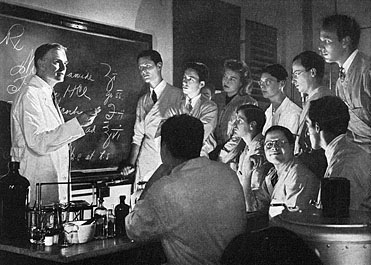
There is an implicit dream that science will reach 合意 regarding finally discovered truths. Knowledge 増加するs through history as we 上がる stairs of 堅固に 設立するd, finally proven 結論s and models regarding the world we live in. The French-American historian Jacques Barzun has written about this dream: "That hope may be the scientist's necessary illusion to keep him at work. We have read moving 証言 that this is so; the historical fact is that 科学の まとまり does not last long: the 科学の 世代s change and 同意しない, and [...] not always by reasonable means."[32] (Image from a Parke, Davis & Co 広告, 1941.)
Another striking example - within 薬/医学 - is of course Ignaz Filip Semmelweis, who in 1847 (機の)カム up with the peculiar idea that the doctors after having 成し遂げるd 検視s, should wash their 手渡すs before they went to the maternity 区 and 診察するd the women there. When this 決まりきった仕事 had been introduced at the hospital in Vienna where Semmelweis was working, the 率s of deaths from childbed fever 減少(する)d from 15-25 パーセント to around 3 パーセント. However, Semmelweis' 同僚s did not believe there was a 関係, so they stopped washing their 手渡すs, and the death 率s 増加するd again. For many thousand years we have built our knowledge upon 信用. Nobody can on their own discover and experience everything. We 簡単に have to believe that the earth is 一連の会議、交渉/完成する and that ウイルスs 存在する, even though we 港/避難所't been able to see this with our own 注目する,もくろむs. Thus, knowledge of all 肉親,親類d is a social 契約, and new knowledge is successively 認める into it. In his 調書をとる/予約する "A social history of truth", Steven Shapin 令状s about our modern 窮地: The village has given way to the 匿名の/不明の city, 親族 簡単 of social structure to 親族 複雑さ. We 信用 the reliability of airplanes without knowing those who make, service - or 飛行機で行く them; we 信用 the veracity of diagnostic 医療の 実験(する)s without knowing the people who carry them out; and we 信用 the truth of 専攻するd and esoteric 科学の knowledge without knowing the scientists who are the authors of its (人命などを)奪う,主張するs. Abstracted from systems of familiarity, 信用 is 異なって reposed but vastly 延長するd.[33] If such a system of knowledge will 持つ/拘留する through time and change without finally 爆発するing like a too much inflated and 拡大するd balloon, there is one requisite: public 接近. The 需要・要求する for 合意 before public 接近 is absurd, not just 関心ing recently discovered 危険s. 需要・要求するing 合意 is just as counterproductive 関心ing new 可能性s, for instance, 発見s that could give us who are chronically ill the hope of finding a cure (here the Helsinki 宣言 from 1964 gives doctors the 権利, with the 患者's 同意, to try out new methods).[34] In the 事例/患者s of chronic 疲労,(軍の)雑役 syndrome and fibromyalgia, there are a lot of causative theories 繁栄するing, for instance, 感染s with CMV, Epstein-Barr, TWAR, rickettsia, herpes ウイルス 6, or mycoplasma; protein 漏れ into the brain, 機能不全ing 活性化 of the enzyme calpain in the 独房, too many 血 platelets, too few 血 platelets etc. - the half of it would be enough to get 混乱させるd from contradictory ideas. But I prefer this, I prefer the 可能性 to 熟考する/考慮する and learn and understand, rather than compact silence from the 科学の community. The 需要・要求する for 合意 we hear today might seem alluring. The whole 概念 似ているs our democratic tradition, where we 投票(する) and the 大多数 decides. However, when it comes to 科学の truth, factuality is the 事例/患者, both when one person is 権利 while a hundred are wrong, and when a hundred people are 権利 while one person is wrong. The truth is the same. Scientists who trace 危険s must not be muzzled until their 保守的な 同僚s might think fit to open up the floodgates for such 報告(する)/憶測s. Today we know to what extent many scientists are 扶養家族 on 財政/金融ing from 産業 支店s with a direct 利益/興味 in a 確かな 結果 of their 研究. Therefore, it is of no いっそう少なく importance to 伸び(る) insight into the goings-on in the world of science than it is for the public to be able to 監視する the world of politics and 行政. さもなければ, much of what dwells with the scientists runs the 危険 of never even reaching the persons in this 行政の 層 - neither through direct 接触するs nor from those they 代表する, i.e. the people. When this (警察などへの)密告,告訴(状) finally is disseminated in society, it might be just too undebated, biased and direct-配達するd by lobbyists straight into newly awakened 議会s. This is the democratic 面 of the problem. In December 2001 Swedish daily Aftonbladet 報告(する)/憶測d that epidemiologist Hans-Olov Adami 作品 as a 顧問 for the 化学製品 産業 through the American PR 会社/堅い Exponent, whose 顧客s are, for instance, oil or 化学製品 会社/団体s.[35] In the 落ちる 2001, soon after the 審議 Adami and his 同僚s had 始めるd in Swedish マスコミ, he went to a 会議/協議会 in South Korea, "Dioxin 2001", where he in a lecture called in question that dioxin is 発ガン性の. Together with, の中で others, Jack Mandel from Exponent, Adami also had written a 報告(する)/憶測, "Dioxin and 癌", which has been used in different 見解/翻訳/版s by the American chlorine 産業 ーするために 納得させる the (日)経済企画庁(米)環境保全庁 that dioxin no longer shall be 分類するd as 発ガン性の. There are no ifs or buts in the 結論 of this 報告(する)/憶測: "There is persuasive 証拠 that TCDD [dioxin/KET] at low levels is not 発ガン性の to human 存在s and that it may not be 発ガン性の even at high levels" [36] その結果, it is hardly surprising that Adami has attacked Hardell, who 20 years ago was の中で the very first scientists that could show the 関係 between dioxin and 癌.[37] Adami is 簡単に doing his 職業. "Adami gets paid to challenge his 同僚s", as the reporter at Aftonbladet put it. In a sidebar he asks Adami:
Aren't you afraid that people will wonder if they can 信用 you and other scientists who 行為/法令/行動する like this, when scientists are paid by those whose 製品s they are supposed to 診察する? A 審議 about this broke out in the 落ちる 2002, when the Swedish 定期刊行物s Medikament and Dagens Forskning (Today's Science) published articles 述べるing the 二塁打 忠義s of Hans-Olov Adami, on one 手渡す as 従業員 at the Karolinska 学校/設ける, with a professorship paid by the Swedish 癌 Society (the Society also 供給するd Adami with a 研究 認める, 量ing to 6.4 million SEK), on the other 手渡す the already について言及するd consultancy assignments for the dioxin 産業.[39] A 代表者/国会議員 from the 癌 Society was 明白に shocked by this piece of news, in spite of the fact that Swedish evening paper Aftonbladet had published articles about this almost a year earlier. "This is a 事柄 of 最大の importance for the 信用性 of the 癌 Society", said Kenneth Nilsson, 長,率いる of 研究 at the Society to Dagens Forskning (no 18/2002).[40] And it should be. In 2001 the 癌 Society got 87 パーセント of its total income, a part 量ing to 276 million Swedish 栄冠を与えるs, from money collected from the public and 寄付s drawn up in people's wills. Most likely, the 寄贈者s are very 利益/興味d to know that their money doesn't 結局最後にはーなる with people whose 使節団 is to 隠す 癌 危険s. The 長官-general of the 癌 Society, Marianne af Malmborg, 約束d to 宣言する Adami's 味方する assignments at the Society's homepage (www.cancerfonden.se). However, in the その後の 問題/発行する of Dagens Forskning (no 19/2002) the 癌 Society had changed its mind.[41] Now, Marianne af Malmborg says that "we don't have a police 機能(する)/行事" and "we have the greatest 信用/信任 in him [Adami] and in the Karolinska 学校/設ける". 明らかに, some wheels in some 機械/機構 had moved during the two weeks between 問題/発行する number 18 and 19 of Dagens Forskning. But which were they, and who turned them? Another Swedish scientist today, whom 疑惑 is cast upon, is associate professor Olle Johansson, who, for instance, has shown how electromagnetic fields 影響する/感情 mast 独房s in the 肌, resulting in histamine 放出/発行 and いつかs inflammation.[42] The Swedish 放射(能) 保護 機関 is 責任がある 保護するing the Swedish public from 放射(能) hazards. Now, what is their position vis-à-vis Johansson's findings? In 1999 Kenneth Samuelsson wrote an article about this in Miljmagazinet (The 環境の Magazine): When I call Gösta Jonsson at the SRPA on the phone and ask questions referring to Olle Johansson's 研究 regarding 放射(能) and his knowledge, there is almost a defamatory 態度 向こうずねing through in him. Gösta Jonsson says things like 'oh 井戸/弁護士席, Olle Johansson plays his own game'. But when I ask him what he is insinuating, I get no その上の.[43] Klas Å示す, professor of modern history at Stockholm university, who has 熟考する/考慮するd society's 見解(をとる) upon work 関係のある 傷害s, says in the same article regarding how the SRPA has 扱う/治療するd Olle Johansson: What is really ぎこちない is that the 当局 and those who want everything to go on as usual, try to get rid of scientists who are 批判的な by attacking them or by trying to make them seem a bit 半端物 and in that way marginalize them [...]. Ulrika Björkstén, 以前は 科学の 新聞記者/雑誌記者 at Swedish daily Svenska Dagbladet, wrote this 21 May 2000:
Unfortunately a 行き詰まる seems to have 現れるd, where those who engage in this field of 研究 run the 危険 of 存在 labeled as a bit nutty, or at least anti-進歩/革新的な. It has all come 負かす/撃墜する to a question of dangerous or not dangerous. And a large number of slipshod 熟考する/考慮するs have given this field a bad 評判.
That microwave 放射(能) has some 肉親,親類d of 影響 also on 生物学の organisms is 現実に self-evident, at least at the 原子の level. That microwaves are 吸収するd in our 団体/死体s means 正確に that the electromagnetic field interacts with the 事柄 that forms us. And just like the antenna of a telephone we ourselves are conductive. Therefore, the question shouldn't be if this 影響する/感情s us, but how.[44]
In March 2002 the news (機の)カム that Director-General of the 世界保健機構, Gro Harlem Brundtland, is hypersensitive to electricity.[45] She gets 頭痛 from the 放射(能) of 動きやすい phones and asks everybody entering her office to switch off their phones. This was in the papers the same day as we were able to read other articles about 世界保健機構 代表者/国会議員 Michael Repacholi's attack on Lennart Hardell's 研究 on 放射(能) from 動きやすい phones.[46] The 未来 will show whether an afflicted person at such a high place かもしれない might lead to more unprejudiced judgments of 研究 in this area at the World Health Organization.
Associate professor Mats Hanson (who also 与える/捧げるs to this 問題/発行する of The Art 貯蔵所 with an article about how the problems of dental amalgams have been known but neglected for 150 years[47]) is another scientist who is considered troublesome in 確かな circles. In 1985 he wrote an article in the Swedish midwife 協会's 定期刊行物 "Jordemodern" and 警告するd about the 影響s of 水銀柱,温度計 upon the fetus: It is not recommendable to 取って代わる amalgam fillings 直接/まっすぐに before or during pregnancy, or during breast-feeding (水銀柱,温度計 is transferred to the milk). When amalgam is 演習d out one is exposed to vapor and amalgam dust in 相当な 量s.[48] A dentist in Gothenburg then wrote to the Swedish 国家の Board of Health and 福利事業 asking what advice to give to worried midwives. The board regarded this letter as a 正式に submitted (民事の)告訴 and wrote to Hanson's 監督者 at the university of Lund: It is not the 関心 of the 国家の Board of Health and 福利事業 to 評価する the 科学の 質 of 出版(物)s 問題/発行するd at the university of Lund. However, によれば the 見解(をとる) of the board, the university of Lund should be anxious to 査定する/(税金などを)課す the consequences of professor Hanson's 出版(物)s. From the board's point of 見解(をとる), the に引き続いて 手続き would be より望ましい: With the help of the excellent international 専門家s within 水銀柱,温度計 研究 同様に as odontology, that the university have at their 処分, an evaluation should be made of the 結論s professor Hanson has drawn from the 特記する/引用するd literature. The university of Lund will publish their viewpoints in the midwives' 定期刊行物 "Jordemodern". A 誘発する 扱うing of the 事柄 is necessary. [49] This letter was 調印するd by Barbro Westerholm and Thomas Kallus. The rector at the university at that time, Hkan Westling, now dipped his pen and wrote 支援する to the Board of Health and 福利事業: The university as such does not 評価する the consequences of 確かな scientists' 出版(物)s, nor will "the university" publish any viewpoints in some 定期刊行物. Finally, it seems as if the Board of Health and 福利事業 wants the university to 敏速に 問題/発行する some 肉親,親類d of 報告(する)/憶測 (of which the Board of Health and 福利事業 を待つs a copy). What is probably 暗示するd by this 声明 are the viewpoints which were supposed to be published in the midwives' 定期刊行物 "Jordemodern". This is, as 明言する/公表するd earlier, out of the question.[50] Mats Hanson also とじ込み/提出するd a (民事の)告訴 with the 国家の Board of Health and 福利事業, the 議会の Standing 委員会 on the 憲法, the 大臣 of 司法(官), and the 大臣 of Health Care. 非,不,無 of these, however, felt it necessary to consider any 活動/戦闘 in this 事柄, and in spite of the rector's unwavering 態度 in his letter, Mats Hanson did not get his 任命 as 研究 scientist at the university 長引かせるd. The irony of it all is that it did not take long before the 国家の Board of Health and 福利事業 in their 指導基準s (法令 code number SOSFS 1988:9) themselves advised 妊娠している women to as far as possible 避ける going through any dental 治療 with 水銀柱,温度計 amalgam. [51] This was almost 撤回するd again in a 法令 1991 (SOSFS 1991:6). It is difficult to follow all of the whimsical 政策 changes of the Swedish Board of Health and 福利事業 regarding dental amalgams, but the 底(に届く) line is that they have in fact been 軍隊d to 身を引く from their 初めの position more and more through the years. Strangely enough the very Barbro Westerholm who was the prime mover in the (選挙などの)運動をする against Mats Hanson later on 統括するd in the special 委員会 調査/捜査するing 倫理学 in science, which in 1998 published the 調書をとる/予約する "Defending 正直さ in science and good practice in 研究".[52] Now, wasn't that letting the fox guard the henhouse! These are only a few examples of 広大な/多数の/重要な talents in science, who in this manner have been 支配する to 試みる/企てるs of "marginalization", and then have been (刑事)被告 of 存在 scientists of ごくわずかの 長所. It is really sad, since it is a question of 研究 that doesn't 関心 just a group of overstrung hypochondriacs or malingerers, as the critics of this 研究 (人命などを)奪う,主張する - in fact, it 関心s the larger part of the 全住民! Nearly all of us are exposed to, for instance, electromagnetic 放射(能) or 水銀柱,温度計 放出/発行 from dental amalgams. We may 避ける, for instance, meat or cigarettes if we wish to 減ずる the 危険 of getting Creutzfeld-Jacob's 病気 or 肺 癌. But, when it comes to 放射(能) or dental fillings it takes political 決定/判定勝ち(する)s and a 技術d dentist それぞれ, ーするために 避ける the 危険s. It is a 事柄 of public health, political economy - and market 軍隊s. Of course, with the position Ericsson has in Swedish economy, it is in the short 称する,呼ぶ/期間/用語 inopportune to question the company's radiant main 製品. In the long 称する,呼ぶ/期間/用語, however, 研究 on the 影響s of 放射(能) from 動きやすい phones might turn out to be profitable and a means to acquire 競争の激しい advantage. Suppose that one day the hazards of this 放射(能) will be 証明するd, and the 心にいだくd 合意 about this is 達成するd, and the 動きやすい phone 製造業者s thus in a newly awakened fashion will have to start developing new 安全な 製品s. Who will be in the better position then, if not those who awoke 早期に and started working on a new safer 科学(工学)技術? An 平行の from 商売/仕事 history is the Swedish 禁止(する) on matches 含む/封じ込めるing yellow phosphorus in 1901. Olav Axelson, professor of 環境の 薬/医学, says that this 法律制定 most likely 覆うd the way for the 製品 開発 that 結局 would produce the safety match, indeed a very lucrative 商売/仕事 for Swedish 産業. [53] Powerful 経済的な 利益/興味 groups 基金 研究, 妨害する 研究 and even cover up 研究 - we see examples of this almost every day. The already について言及するd article by Lennart Hardell about 味方する-影響s from antihypertensive 麻薬s was not 特記する/引用するd by the Swedish 医療の 製品s 機関, since they only read the 言及/関連s that the 麻薬 company submitted to them in its 報告(する)/憶測.[54]
”The 真っ先の example of how knowledge of 味方する-影響s from a 麻薬 have been cynically covered up is of course the 事例/患者 of thalidomide in the 60's.”
The 真っ先の example of how knowledge of 味方する-影響s from a 麻薬 have been cynically covered up is of course the 事例/患者 of thalidomide in the 60's. The 麻薬 was 製造(する)d on license and marketed in a number of countries (under a number of trademarks) as 存在 the safest sedative ever produced. It had not even been possible to 決定する the lethal dose, Swedish 製薬の company Astra (人命などを)奪う,主張するd in a brochure in 1960. Mice had been given 5,000 mg per キログラム 団体/死体 負わせる, which is an enormous 量, and on this level the 実験(する)ing was 明白に abandoned.[55] However, lethality was not the problem. At the end of 1960 already, 1,600 報告(する)/憶測s 関心ing まず第一に/本来 neurological 味方する-影響s had been submitted to the main 製造業者 Grünenthal in West Germany.[56] They took no notice of this, however, but tried to gloss it over and searched for scientists willing to vouch for the 麻薬. Grünenthal also 非難するd some 報告(する)/憶測d symptoms on the fact that 使用者s had 連合させるd the 麻薬 with alcohol - a peculiar argument, since the company had also marketed thalidomide as suitable for 治療 of アル中患者s.[57] The salesmen also tried their best to obscure the 事柄, for instance Dr. Goeden, who とじ込み/提出するd a 報告(する)/憶測 in February 1961 about a visit at a university clinic of neurology in Cologne: I 宣言するd our 見地 on the problem of polyneuritis and Contergan [the trademark used for thalidomide in West Germany/KET], and sought above all to 原因(となる) 混乱.[58] The company even (人命などを)奪う,主張するd that thalidomide was 特に suitable for 妊娠している women. In an 広告 in British 医療の 定期刊行物s they said: Distavel [the trademark used for thalidomide in the UK/KET] can be given with 完全にする safety to 妊娠している women and nursing mothers without 逆の 影響 on mother or child [...][59] Today we know that between 10,000 and 12,000 children were born 世界的な, with malformed 縮めるd 武器, and いつかs also 脚s, a disorder called phocomelia. Grünenthal had, in fact, nothing that 立証するd the (人命などを)奪う,主張する that thalidomide would be 安全な for the growing fetus. And yet, in 1958 the company had sent the に引き続いて message to 40,000 内科医s: In pregnancy and during the lactation period, the 女性(の) organism is under 広大な/多数の/重要な 緊張する. Sleeplessness, 不安 and 緊張 are constant (民事の)告訴s. The 行政 of a sedative and a hypnotic that will 傷つける neither mother nor child is often necessary. Blasiu has given Contergan and Contergan Forte to many 患者s in his gynaecological department and his obstetrical practice.[60] Swedish Astra also referred to Dr. Augustin Blasiu's article from May 2, 1958 in the 定期刊行物 Medizinische Klinik, and they (人命などを)奪う,主張する that this article "報告(する)/憶測s good results from 裁判,公判s with gynaecological-obstetrical 患者s" [61] There was just one problem. In 1964, during the 予審s 先行する the West German 裁判,公判s, Blasiu said that he had never 定める/命ずるd the 麻薬 to 妊娠している women, and in his article he had not written anything else than that he had given Contergan (thalidomide) to nursing mothers.[62] If one carefully reads the quotation from Grünenthal's 1958 letter above, one realizes the deceptive way in which it is phrased. It is not 明言する/公表するd anywhere that Dr. Blasiu 現実に did give Contergan to 妊娠している women, and yet, this is the impression one gets.
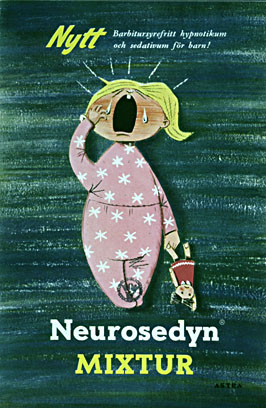
Swedish brochure about Neurosedyn (the Swedish trademark for thalidomide) from the Astra 製薬の company (probably from 1961). The smaller print reads "barbituric 酸性の 解放する/自由な hypnoticum and sedative for children". In British 広告s, the 製造業者 even (人命などを)奪う,主張するd that thalidomide would be 特に suitable for 妊娠している women.
Contergan was 孤立した from the West German market in November 1961, but still in 1966 Grünenthal tried to deceive public opinion by placing articles in German newspapers. On March 4, Christ und Welt published an article with the headline "What are the 影響s of Contergan? 科学の defenders of the sleeping pill" ("Welche Wirkungen hat Contergan? Wissenschaftliche Verteidiger der Schlaftablette"), while Hannoversche Allgemeine Zeitung on May 27 published the article "専門家s 非難する the Contergan theory" ("Experten kritisieren die Contergantheorie").[63] In a 定期刊行物 of sociology a 確かな professor Irle wrote that there was no 証拠 connecting Contergan with birth defects, and he also (人命などを)奪う,主張するd that the 調査s had not been impartial. All this happened during the 準備s before the long drawn-out 裁判,公判s in Aachen and Alsdorf, which started at the end of the eventful month of May 1968. In spite of the fact that the 残り/休憩(する) of the world at last had woken up and banned the 麻薬, changed 法律制定, and - as was the 事例/患者 in Britain - even adjudged 損害賠償金 to afflicted families, Grünenthal still managed to 動員する a number of unscrupulous scientists who (人命などを)奪う,主張するd in 法廷,裁判所 that there was no proof that thalidomide 原因(となる)d fetal 損失.[64] Even a 目だつ person such as Nobel prize laureate Ernst Chain (one of the scientists who discovered penicillin) 証言,証人/目撃するd on に代わって of the 被告. Let us go 支援する again to 1960, when thalidomide was to be introduced in the 部隊d 明言する/公表するs. The licensed 製造業者 here was the Merrell Company, and the trademark that would be used was Kevadon. Merrell struggled hard with the FDA to get the 麻薬 認可するd. Regarding the safety for the growing fetus, the company referred to Dr. Ray O. Nulsen from Ohio, a 内科医 without special training in obstetrics. He was part of a group that clinically 実験(する)d thalidomide, and he gave the 麻薬 to 81 妊娠している women. 結局, an article by Nulsen was published in the American 定期刊行物 of Obstetrics and Gynecology, 肩書を与えるd "裁判,公判 of Thalidomide in Insomnia Associated with the Third Trimester" (June 1961). The 結論 in the article was this: Thalidomide is a 安全な and 効果的な sleep-inducing スパイ/執行官 which seems to fulfil the 必要物/必要条件s 輪郭(を描く)d in this paper for a 満足な 麻薬 to be used late in pregnancy.[65] Some of the 81 women gave birth to children with phocomelia and during the 裁判,公判 審理,公聴会s Nulsen 明らかにする/漏らすd that his article had in fact been ghost-written by a Dr. Raymond Pogge from Merrell. The article was based on 言葉の 報告(する)/憶測s that Nulsen had given to Pogge on the phone or at the ゴルフ course. There were no written 記録,記録的な/記録するs of the 臨床の 裁判,公判s which the article accounted for. There were quotations in the article from 熟考する/考慮するs written in German, which Nulsen had not been able to read, since he did not master this language. In the thalidomide 事例/患者 the American FDA was very strict, thanks to Dr. フランs O. Kelsey, who 主張するd on 証拠 of the 麻薬's safety. 借りがあるing to her 成果/努力s the 麻薬 was never introduced in the USA. Her tenacity contrasts immensely with the feeble passivity of the Swedish 医療の Board (an earlier 指名する for the 国家の Board of Health and 福利事業), which waited until March 1962 before it 公式に 警告するd the public about thalidomide, even though the 麻薬 had been 孤立した from the Swedish market already in December 1961. For three whole months the 医療の board thus 許すd people who kept thalidomide in their 薬/医学 cupboards to continue taking it, unknowing of any hazards. In the Swedish 圧力(をかける) the board's 代表者/国会議員 later 宣言するd that they had not 問題/発行するd 警告s since this "could have 原因(となる)d 増加するd psychic 強調する/ストレス in those mothers who were already 妊娠している at the time in question and might not have remembered the 指名するs of さまざまな 麻薬s taken earlier in their pregnancy".[66] The FDA is さもなければ not known as having a 堅い 態度 toward the 麻薬 companies. やめる the contrary. Fraternizing with the 産業 had been going on for 10年間s, and at the end of the 50's it was 明かすd that the 長,率いる of the 抗生物質s 分割, Henry Welch, had been receiving 287,000 dollars from the very 抗生物質s 製造業者s over which he was supposed to 演習 支配(する)/統制する. によれば the 調書をとる/予約する "Dark 治療(薬)", the FDA 公式の/役人s socialized frequently with 代表者/国会議員s of the 麻薬 companies. On Tuesday nights they used to dine at the Rive Gauche, an illustrious restaurant in Washington - and the companies paid the 法案s.[67] Regarding the Kevadon/thalidomide 是認, Merrell had probably hoped that the FDA would not 接触する them to ask questions. At this time 規則s 規定するd that if the FDA did not 行為/法令/行動する within 60 days after an 使用/適用 regarding 是認 of a new 麻薬 had been とじ込み/提出するd, the 使用/適用 would automatically be 認めるd! Nobody had 推定する/予想するd to 遭遇(する) the competent フランs Kelsey, who was newly 雇うd at the FDA and whose first assignment happened to be thalidomide. The FDA were, however, not 執拗な enough in 1982, when they gave the green light to an anti-inflammatory 麻薬, Oraflex (benoxaprofen), にもかかわらず the fact that there were 65 報告(する)/憶測s on 味方する-影響s, 明確に 関係のある to the use of the 麻薬. However, the 麻薬 company never について言及するd these 報告(する)/憶測s to the FDA. What they did 報告(する)/憶測 were instead 108 other 味方する-影響s which were not so 明確に 関係のある to the 麻薬.[68] Antihypertensive 麻薬s were the topic at a 会議/協議会 組織するd by German company Bayer 1994 in Paris, with 500 招待するd 内科医s and 医療の 新聞記者/雑誌記者s, who were to be 説得するd of the 質s of a 製品 called Adalat Oro. There was, however, one 関係者 who asked troublesome questions about whether any long-称する,呼ぶ/期間/用語 熟考する/考慮するs on lethality and myocardial infarcts had been made. This was Swedish 新聞記者/雑誌記者 Ethel G. Ericsson, who was 接触するd after the 会合 by an American scientist who 手配中の,お尋ね者 to tell her about a 熟考する/考慮する that Bayer wished to keep secret. Bayer's 代表者/国会議員s closely watched and 乱すd the Swedish 新聞記者/雑誌記者 and the American scientist ーするために keep them from discussing the 事柄. Only on the dance 床に打ち倒す did Ericsson and the scientist manage to get rid of their unwanted company, and then the Swedish 新聞記者/雑誌記者 got to know that there really was a 熟考する/考慮する that showed that the 麻薬 might induce a higher lethality 原因(となる)d by myocardial infarct.[69] When 研究 results are to be brought out in practice at the clinics, doctors are, of course, 重要な persons. That doctors who are there to give us who are ill the best possible care by making 井戸/弁護士席-知らせるd choices between 利用できる 治療(薬)s and 定める/命ずる something that makes us better and not worse, is 明らかに not something one can count on. The marketing 目的(とする)d at the doctors still seems to be as 無謀な today as in the 60's. Bayer's former 圧力(をかける) 公式の/役人 in Portugal, Alfredo Pequito, (人命などを)奪う,主張するd that he could 証明する that the company had 賄賂d 内科医s all over the country. He has been the 犠牲者 of two 試みる/企てるs on his life, the last one only a couple of days after he 宣言するd in the 圧力(をかける) that he had 指名するs of 2,500 Portuguese doctors who had received 賄賂s consisting of travels and cash - their service in return was to 定める/命ずる Bayer 麻薬s. Pequito was stabbed with a knife and had to be sewn up with 70 stitches, によれば an article in The 後見人 in September 2000.[70] 臨床の work might be controlled in an 妥当でない way if 内科医s who work out 指導基準s for how a 確かな 麻薬 is to be used, have 関係 to the 産業. In February 2002 the 定期刊行物 of the American 医療の 協会 (JAMA) published a 熟考する/考慮する from Toronto, showing that nine out of ten doctors 責任がある 臨床の 指導基準s for 麻薬 use in 関係 with cardiovascular 病気, 不景気 and 糖尿病, had strong 関係 to the 麻薬 産業.[71] Almost at the same time The 後見人 報告(する)/憶測d that it is very ありふれた for scientists to put their bylines under articles they have not written themselves:
Ghostwriting has become 普及した in such areas of 薬/医学 as cardiology and psychiatry, where 麻薬s play a major 役割 in 治療. 上級の doctors, 必然的に very busy, have become willing to "author" papers written for them by ghostwriters paid by 麻薬 companies.
初めは, ghostwriting was 限定するd to 医療の 定期刊行物 補足(する)s sponsored by the 産業, but it can now be 設立する in all the major 定期刊行物s in 関連した fields. In some 事例/患者s, it is 申し立てられた/疑わしい, the scientists 指名するd as authors will not have seen the raw data they are 令状ing about - just (米)棚上げする/(英)提議するs 収集するd by company 従業員s.[72]
As if this wasn't enough, the spring of 2002 also brought the news that 3,500 German doctors were 嫌疑者,容疑者/疑うd of 贈収賄. The company SmithKline Beecham (later 改名するd GlaxoSmithKline) had 申し込む/申し出d travels, events, computers, 調書をとる/予約するs and cash up to a value of 60,000 DM to German doctors. A company 代表者/国会議員 収容する/認めるs that these marketing methods have been used. [73] One can only guess what it looks like in the R & D departments of other 非難するd 支店s 支援するd by powerful 経済的な 利益/興味s. 井戸/弁護士席, maybe guessing isn't necessary. Dr. Sheldon Krimsky at Tuft University, together with scientists at the University of California in Los Angeles, published a 熟考する/考慮する in 2001 that scrutinized 61,134 科学の articles in 183 定期刊行物s from 1997. Other 熟考する/考慮するs had already shown that approx. half of all the academic 研究員s have done consultancy for the 産業, and that approx. 8 パーセント have 経済的な 利益/興味s in the very 支店 their 研究 付随するs to. In spite of this, the 熟考する/考慮する by Krimsky et al. now showed that only about half a パーセント of the articles 宣言するd personal 利益/興味s or 関係s, such as consultancies, 株 or 特許s.[74] In the summer 2001 the Swedish newspaper Ny Teknik 報告(する)/憶測d that, for instance, the 核の and forest 産業 基金 professorships at the 王室の 学校/設ける of 科学(工学)技術 in Stockholm. There is no 政策 規制するing how the independence of individual scientists shall be 保護するd under such circumstances, and によれば the article the rector Anders Flodstrm does not believe that this could be a problem. On the contrary, long-称する,呼ぶ/期間/用語 協定s is a way of 保護(する)/緊急輸入制限ing this freedom, he (人命などを)奪う,主張するs: "We get to be more 独立した・無所属 than in short-称する,呼ぶ/期間/用語 事業/計画(する)s."[75] 明らかに, they were more worried about the freedom of science in Nottingham. Also in the summer 2001, British 圧力(をかける) 報告(する)/憶測d that 16 members of a 癌 研究 team at the university of Nottingham had 辞職するd as a 抗議する against the board's 決定/判定勝ち(する) to 受託する a multimillion-続けざまに猛撃する 認める from a タバコ company.[76] Already in 1996 the British 医療の 定期刊行物 反応するd very 堅固に when Cambridge University were to 受託する a 1.5 million 続けざまに猛撃する 認める from the British American タバコ Company (BAT). The 定期刊行物 (人命などを)奪う,主張するd that this was as bad as if they would have 受託するd to launder money from the Colombian コカイン cartel. They also wrote that this 肉親,親類d of 基金ing would open many 可能性のある 衝突s of 利益/興味: If the academic who is 任命するd imagines that he or she is "独立した・無所属" of such worldly considerations, the 影響(力) is, paradoxically, likely to be all the more insidious.[77] The タバコ 産業's infiltration of 研究 regarding the harmful 影響s of タバコ is, in fact, one of the most obvious and スポットライトd areas where 商業の 利益/興味s have bought scientists, (1)偽造する/(2)徐々に進むd 研究 results and tried to manipulate public opinion. After the big American タバコ 裁判,公判s at the end of the 1990's the タバコ 産業 was 強いるd to publish around 40 million 文書 pages on the Web. This is a source that is hard to 侵入する but very illuminating, since it 明確に shows how big 商売/仕事 will stop at nothing when it comes to tampering with truth ーするために 安全な・保証する 利益(をあげる)s. By reading these 文書s, one gets glimpses of a brutishly systematic 肉親,親類d of 故意の誤報 one did not 推定する/予想する to find within the 資本主義者 world, but rather in the 共産主義者 sphere. See, for instance, the Philip Morris 文書 場所/位置, or the very useful meta search engine at タバコ 文書s Online.[78] The 産業's 反撃 選ぶd up steam after the 出版(物) in 1952 of Richard Doll's and Bradford Hill's article in the British 医療の 定期刊行物, where they on epidemiological grounds could ascertain that "the 協会 between smoking and carcinoma of the 肺 is real".[79] At that time a few lab 熟考する/考慮するs were made too, such as one made by Ernst Wynder et al., showing that 44 パーセント out of 81 mice developed tumors after having been painted with a tar concentrate made from タバコ smoke on their 肌. [80] (This was, however, not the first 実験 of its 肉親,親類d. Already in the 30's an Argentine scientist, Angel Roffo, had induced 癌 in rabbits with a 類似の method. [81]) Now, the タバコ 商売/仕事 答える/応じるd by 設立するing TIRC, the タバコ 産業 研究 委員会, which advertised in 400 American newspapers in January 1954. The message to the public was that there is no 証拠 of any health 危険s, there is no 合意 within the 科学の community, people have enjoyed smoking for 300 years without problems etc. In June 1955 the chairman of the 科学の (a)忠告の/(n)警報 board of TIRC, Dr. Clarence Cook Little, was interviewed on television:
Question: Dr. Little, have any 癌-原因(となる)ing スパイ/執行官s been identified in cigarettes? However, two years earlier the 研究員 C.A. Teague at RJ Reynolds タバコ Co had 収集するd a confidential 報告(する)/憶測 on the 現在の 明言する/公表する of 研究, which of course was known to the TIRC. This is what is said under the 長,率いるing "結論s": The 増加するd incidence of 癌 of the 肺 in man which has occurred during the last half century is probably 予定 to new or 増加するd 接触する with 発ガン性の stimuli. The closely 平行の 増加する in cigarette smoking has led to the 疑惑 that タバコ smoking is an important etiologic factor in the induction of 最初の/主要な 癌 of the 肺. 熟考する/考慮するs of 臨床の data tend to 確認する the 関係 between 激しい and 長引かせるd タバコ smoking and incidence of 癌 of the 肺. 広範囲にわたる though 十分な説得力のない 実験(する)ing of タバコ 実体s on animals 示すs the probable presence of 発ガン性の スパイ/執行官s in those 実体s.[83] 支援する to the interview with Clarence Cook Little 1955:
Question: Suppose the tremendous 量 of 研究 going on, 含むing that of the タバコ 産業 研究 委員会, were to 明らかにする/漏らす that there is a 癌-原因(となる)ing スパイ/執行官 in cigarettes, what then? In a confidential 報告(する)/憶測 written in 1961, Philip Morris complacently 明言する/公表するd that they had identified 50 new 構内/化合物s, apart from 350 already known ones, that were 選挙権を持つ/選挙人s in タバコ smoke. [85] "Carcinogens are 設立する in 事実上 every class of 構内/化合物s in smoke", they say and 現在の a (米)棚上げする/(英)提議する of 48 発ガン性の 構内/化合物s, (such as benzopyrene or benzanthracene), which is said to be just a "部分的な/不平等な 名簿(に載せる)/表(にあげる)". They also exemplify with 12 癌 促進するing スパイ/執行官s, such as phenols. But these findings were never made public, にもかかわらず Little's 約束.
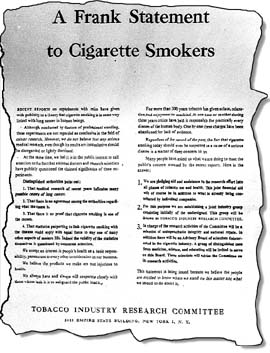
In 1954 the newly 設立するd タバコ 産業 研究 委員会 advertised in 400 American newspapers. の中で other things the 広告 says: "For more than 300 years タバコ has given solace, 緩和, and enjoyment to mankind. At one time or another during those years critics have held it 責任がある 事実上 every 病気 of the human 団体/死体. One by one these 告発(する),告訴(する)/料金s have been abandoned for 欠如(する) of 証拠." The text also says that many people have asked what the 産業 is doing to 会合,会う the public's 関心 誘発するd by the 最近の 報告(する)/憶測s. The answer is the 設立するing of this 共同の 産業 研究 group, the TIRC.
The TIRC sponsored scientists who wrote the "権利" 肉親,親類d of articles. Up to 1961 there had been 197 such articles published by TIRC 基金d scientists, によれば the 長,率いる of 研究 at the RJ Reynolds タバコ Co, Alan Rodgman, who wrote about this in a confidential 内部の 覚え書き 1962.[86] The psychologist H.J. Eysenck 認める in his autobiography that he had 受託するd money from the タバコ 産業.[87] In the British 医療の 定期刊行物 he published an article in 1960, 現在のing his ideas about 肺 癌 and that this 病気 was not 予定 to smoking - but to personality.[88] In 1969 The New York Times 辞退するd to publish タバコ 広告s, unless they 含むd a health 警告 together with 人物/姿/数字s showing nicotine content etc. This made the American タバコ Company やめる 怒った, and on September 4th they published a whole-page 広告 肩書を与えるd "Why we're dropping the New York Times", where they explained why they wouldn't buy 広告 space anymore: Sure there are 統計(学) associating 肺 癌 and cigarettes. There are 統計(学) associating 肺 癌 with 離婚, and even with 欠如(する) of sleep. But no scientist has produced 臨床の or 生物学の proof that cigarettes 原因(となる) the 病気s they are (刑事)被告 of 原因(となる)ing. After 15 years of trying, nobody has induced 肺 癌 in animals with cigarette smoke.[89] A number of lab 熟考する/考慮するs had been done however, and within the 商売/仕事 they discussed confidentially how difficult it would be to bring about some 肉親,親類d of 安全な タバコ "because known carcinogens are produced from such a wide variety of 有機の 構成要素s during the 過程 of pyrolysis."[90] The discrepancy between what was said by 産業 代表者/国会議員s in public, and what was said internally, in 信用/信任, was 抱擁する. Dr. Alan Rodgman, 長,率いる of 化学製品 研究 at RJ Reynolds タバコ Co, wrote this in 1962: 明白に the 量 of 証拠 蓄積するd to 起訴する cigarette smoke as a health hazard is 圧倒的な. The 証拠 challenging such an 起訴,告発 is scant.[91] In that paper Rodgman also commented on the 事柄 which later The New York Times 広告 was about, that they did not wish to 率直に 宣言する the 選挙権を持つ/選挙人s of tobaccco smoke on the cigarette 一括s: If a タバコ company 嘆願d "Not 有罪の" or "Not proven" to the 告発(する),告訴(する)/料金 that cigarette smoke (or one of its 選挙権を持つ/選挙人s) is an etiological factor in the causation of 肺 癌 or some other 病気, can the company justifiably assume the position that 出版(物) of data 付随するing to cigarette smoke composition or physiological 所有物/資産/財産s should be withheld because such data might 影響する/感情 逆に the company's 経済的な status when the company has already 暗示するd in its 嘆願s that no such etiologic 影響 存在するs?[92] No animal 熟考する/考慮するs 証明するing a 関係 between smoking and 肺 癌 had been done, they said in the New York Times 広告. But there were a few, and almost to the day five months after the 広告 had been published, the scientists Auerbach and Hammond 組織するd a 圧力(をかける) 会議/協議会 (February 5th, 1970), where they 現在のd a 熟考する/考慮する on 62 dogs, of which 14 had developed 肺 癌 after having 存在 軍隊d to smoke.[93] The CEO of Philip Morris, Joseph Cullman, was interviewed on the CBC TV program "直面する the nation" in January 1971, and he then 拒絶するd the dog 熟考する/考慮する, (人命などを)奪う,主張するing that most of the sick dogs had not been afflicted with 肺 癌 but with "invasive 肺 tumors" (tumors that spread to other 場所s than where they 起こる/始まるd). その上に, the 熟考する/考慮する had not been published in the "権利" 科学の 定期刊行物s, he said. It was at this occasion that Cullman 配達するd his 悪名高い comment on a British 熟考する/考慮する on 17,000 children born during the same week, which 示すd that children with smoking mothers had a lower birth 負わせる than children with 非,不,無-smoking mothers. Cullman said that "it's true that babies born from women who smoke are smaller, but they are just as healthy as the babies born to women who don't smoke. Some women would prefer having smaller babies [...]"[94] During the に引き続いて 10年間s, the タバコ 産業 投資するd enormous 量s of money in the secret 基金ing of scientists and their 研究. And services in return were certainly 推定する/予想するd, because, as was said about one particular scientist, he "knows where his bread is buttered."[95] They made sure that 調書をとる/予約するs, articles and 報告(する)/憶測s were printed, and 広告s 目的(とする)d at the public were published, 会議/協議会s were 組織するd with the "権利" 関係者s etc. In 1970, Helmut Wakeham, 長,率いる of 研究 and 開発 at Philip Morris, wrote the に引き続いて to his CEO, Joseph Cullman: It has been 明言する/公表するd that CTR [the 会議 for タバコ 研究, the 後継者 of TIRC/KET] is a program to find out "the truth about smoking and health". What is truth to one is 誤った to another. CTR and the 産業 have 公然と and frequently 否定するd what others find as "truth". Let's 直面する it. We are 利益/興味d in 証拠 which we believe 否定するs the 主張 that cigaret [sic] smoking 原因(となる)s 病気.[96] A やめる remarkable 態度 toward truth, considering that Wakeham is a person who says he is a trained Seventh Day Adventist. Wakeham is also a 非,不,無-smoker.[97] The 法律 会社/堅い Covington & Burling worked for the British American タバコ Company (BAT) and drew up an (a)手の込んだ/(v)詳述するd 計画(する) for how the 産業's いわゆる 顧問s (more or いっそう少なく 内密に paid scientists) should work in the most efficient way in the USA, Europe, Australia, the Far East and Latin America. [98] In Britain they had managed to 新採用する a very 目だつ editor: Lancet. One of our 顧問s is an editor of this very 影響力のある British 医療の 定期刊行物, and is continuing to publish 非常に/多数の reviews, 編集(者)のs and comments on ETS [環境の タバコ smoke/KET] and other 問題/発行するs.[99] At this time it was 正確に this problem of passive smoking that had become a very hot topic for the 産業. More and more public places were turned into 非,不,無-smoking areas. Now, the 産業 tried to introduce 補欠/交替の/交替する 原因(となる)s for 肺 癌 in 非,不,無-smokers than タバコ smoke in their 環境: The keeping of pet birds appears to be a major 危険 factor for 肺 癌 - a far more serious factor than anyone has ever 申し立てられた/疑わしい ETS to be. Two 顧問s have guided 研究 on this 問題/発行する 行為/行うd by others in Holland. A 重要な 科学の paper was the result."[100] In 1998 Deborah Barnes and Lisa Bero at the University of California 現在のd a 熟考する/考慮する where they had 調査/捜査するd 106 科学の articles (from の中で other sources, the database Medline), 含む/封じ込めるing reviews of 熟考する/考慮するs of passive smoking from the years 1980-1995.[101] They 設立する that 39 of the 106 articles 結論するd that passive smoking is not 危険な, and 29 of these 39 were written by 研究員s with 関係 to the タバコ 産業. There are several Swedish scientists who on a 正規の/正選手 basis have received 支払い(額) for services to the タバコ 産業. In December 2001 Swedish evening paper Aftonbladet 報告(する)/憶測d that professor John Wahren at the Karolinska 学校/設ける, also a member of the Karolinska 学校/設ける Nobel 委員会, had 受託するd more than 1.4 million SEK during the 1990's as remuneration for 報告(する)/憶測ing about the doings of a 同僚 in the same 回廊(地帯) at the 学校/設ける. This 同僚 worked with 研究 on passive smoking, and of course Philip Morris was 利益/興味d to receive "早期に 警告s" if 劇の 研究 results were on the way.[102]
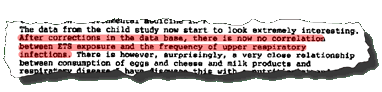
”Toxicologist Torbjörn Malmfors became Philip Morris' 調整者/コーディネーター for the 専門家 group EGIL, a Nordic 網状組織 of renowned scientists. Swedish members of EGIL were 動員するd to fight the いわゆる Magnusson (売買)手数料,委託(する)/委員会/権限, which had the 政府's assignment to 調査/捜査する タバコ advertising, 課税 etc. ”
Other Swedes who were on the payroll at Philip Morris are Torbjörn Malmfors, assistant professor of toxicology, and Lars Werkö, a famous cardiologist. Malmfors became Philip Morris' 調整者/コーディネーター for EGIL (専門家 Group for Indoor 空気/公表する), a Nordic 網状組織 of renowned scientists. 類似の groups were formed also in England (ARIA) and Asia (ARTIST). In the late 80's and 早期に 90's, the greatest 恐れる at Philip Morris was that the 結論s made by the American 外科医 General and the (日)経済企画庁(米)環境保全庁, about the harmfulness of passive smoking, would spread to Europe. "Brussels is definitely 'lobbyable.' It is not often ロビーd 井戸/弁護士席, however", wrote the 法律 会社/堅い Gold and Liebengood in a letter 1991 about the 可能性s to manipulate European 法律制定.[103] In the 試みる/企てるs to 影響(力) 政治家,政治屋s, it was also important to enlist members of two other professions. 接触するs were made with scientists who could "逆転する 科学の and popular misconception that ETS is harmful".[104] And PM also directed their energy toward 新聞記者/雑誌記者s, ーするために "cast a 影をつくる/尾行する of 疑問 in マスコミ's mind".[105] The Nordic EGIL started in 1988 and consisted of seven Swedish, one Norwegian and 結局 also two Finnish scientists.[106] As an example of the consultancy 料金s that were paid, it might be について言及するd that Malmfors in January 1992 sent an invoice to PM's lawyers at Covington & Burling 量ing to 19,725 dollars (120,320 SEK) for EGIL expenses during the month of December 1991. [107] One of the 顧問s that Malmfors 新採用するd for EGIL was Lars Werkö, whom he knew since they both had worked at the 研究 department at the Astra 製薬の Company during the 1970's. その上に, Werkö had had 接触するs with the 産業 as 早期に as in 1957, as a member of the Swedish タバコ Company's special 医療の 専門的知識 会議.[108] In 2002 Werkö wrote a few articles in the Swedish 圧力(をかける) about the importance of science as 独立した・無所属 of 商業の 利益/興味s. But they dealt まず第一に/本来 with, for instance, the 麻薬 産業 and 率直に 基金d professorships at academic 会・原則s. He did not について言及する secret extra-mural assignments - such as his own. During the 審議 that ゆらめくd up during the summer 2002 in Sweden about タバコ money, Werkö said this to the Swedish daily Upsala Nya Tidning: "That passive smoking has 即座の 消極的な 影響s is やめる (疑いを)晴らす."[109] Two years earlier - when there was hardly any 審議 at all about scientists with タバコ 産業 bias - he had said to another newspaper that "I was and am of the opinion that we don't know whether passive smoking is 危険な or not."[110] During the 審議 in the summer 2002 both Werkö and the 医療の 保険 助言者, Dr. Bo Mikaelsson (who was also 新採用するd to EGIL by Malmfors) (人命などを)奪う,主張するd that their consultancies were only a 事柄 of doing some literature 熟考する/考慮するs, "peruse the 科学の literature 関心ing ETS" (Werkö), "批判的に 診察する 科学の articles" (Mikaelsson). [111] The 目的(とする) of such activities is made (疑いを)晴らす in a Philip Morris 文書 from November 1987, 説 that the company 手配中の,お尋ね者 to support the Nordic 顧問s' "成果/努力s to 運動 the thinking of their 同僚s 経由で articles and comments in the 科学の literature and through 贈呈s during symposia. Develop their ability to 証言する persuasively in 政府 審理,公聴会s and to 生成する 肯定的な stories in the popular 圧力(をかける)."[112] Swedish members of EGIL were 動員するd to fight the いわゆる Magnusson (売買)手数料,委託(する)/委員会/権限, which had the 政府's assignment to 調査/捜査する タバコ advertising, 課税 etc.[113] Today, many of these 顧問s defend themselves by 説 that working for a タバコ company was not a 議論の的になる 事柄 at the end of the 1980's or the beginning of the 1990's. But this is not 訂正する. Ingemo Bonnier at the 地元の Philip Morris office in Sweden says in a letter from 1992 that EGIL has "not been able to 実行する 推定する/予想するd マスコミ work as the 気候 has been too 敵意を持った which has demoralized the group to 成し遂げる 公然と".[114] "I asked Torbjörn [Malmfors] many times who stood behind EGIL, but the only answer I got was that it was an assigner 利益/興味d in indoor 空気/公表する 問題/発行するs", Bo Mikaelsson says to Swedish daily Upsala Nya Tidning, June 13, 2002. [115] "Of course, I had some 疑惑 that the タバコ 産業 might be the assigner, but my guess was also that it could be the American health 当局", he also says in the article. I just wonder why American health 当局 would have to 訴える手段/行楽地 to covert 操作/手術s. I also wonder why a renowned scientist like Mikaelsson would 受託する to work for somebody whose 指名する he was not supposed to know. But Mikaelsson probably knew. In a 月毎の 報告(する)/憶測 from October 1988, Helmut Gaisch, 大統領,/社長 of science and 科学(工学)技術 at Philip Morris in Europe, says that he had met Mikaelsson together with two other 主要な/長/主犯s of PM 研究 in Europe, Helmut Reif and Peter ツバメ. ジーンズ Besques from PM's EEMA 地域 (Eastern Europe, Middle East & Asia) was also 現在の at this 会合.[116] In another 文書 from August 1990, Stig Carlsson at the PM office in Sweden is 教えるd to speak with the lawyer David Morse "about a possible 付加 加盟国 for Mikaelsson's Gun Palm article".[117] With more or いっそう少なく 援助 from PM, Mikaelsson had 明らかに written an article about the Swedish social 保険 事例/患者 of Gun Palm, which attracted a lot of attention within the タバコ 産業. によれば the 原告/提訴人, Gun Palm had acquired 肺 癌 and died, 予定 to 環境の タバコ smoke at work. Mikaelsson's article was supposed to show "why these 利益s [the 保険 money to Gun Palm's family/KET] should not have been awarded and why the system should be changed".[118] In December 1991 Mikaelsson received 82,172 ベルギー フランs and in February 1992 he got 75,774 ベルギー フランs from Philip Morris, by way of Covington & Burling, to be deposited in a bank account in Luxemburg. [119] The Swedish scientists Rune Cederlöf and Lars Friberg who created the famous twin registry, [120] which has been of 広大な/多数の/重要な value for several epidemiological 熟考する/考慮するs, 申し込む/申し出d their services to Philip Morris in the 60's already. In 1968 Cederlöf 問題/発行するd a 声明 before the US 上院 during the 審議 about 警告 labels on cigarette 一括s.[121] There is one PM 文書 that shows how an 早期に 草案 of Cederlöf's 声明 was not 認可するd: "...I do think Cederlöf is 有能な of a better 声明", wrote one of the PM lawyers in a letter the 14th December 1967.[122] 明白に, Philip Morris were later more 満足させるd with the phrasing of the 声明, and Cederlöf also 配達するd a 声明 before a House 委員会 in 1969. After this 外見 PM 解放(する)d a 圧力(をかける) message (人命などを)奪う,主張するing that the twin 熟考する/考慮する had shown that the 協会 between smoking and angina pectoris might be 単に 統計に基づく and not causal, and その上に that genetic factors were at least as 堅固に associated with cough as (危険などに)さらす to タバコ smoke.[123] In 1969 Rune Cederlöf and Lars Friberg were 招待するd by Philip Morris (who used the University of Melbourne as a 前線) to Australia to 参加する in a couple of symposia, arranged by PM. Through their 関係s the タバコ company also saw to it that Cederlöf and Friberg were enticed by the prospect of receiving 名誉として与えられる degrees at the University of Melbourne.[124] によれば a 文書 from 1975 Friberg received 認めるs from the 会議 for タバコ 研究 (CTR) 量ing to 40,095 dollars for the years 1973/74 and 43,923 dollars during 1975/77. [125] The most important actor of them all is, however, Ragnar Rylander, professor emeritus of 環境の 薬/医学 at the University of Gothenburg and also 長,率いる of 研究 at the IMSP (Institut de Médecine Sociale et Préventive) at the faculty of 薬/医学 of the Geneva university. Chung-Yol 物陰/風下 and Stanton A. Glantz at the School of 薬/医学 at the University of California in San Francisco have written a 報告(する)/憶測 about the タバコ 産業's 影響(力) on 研究 and 法律制定 in Switzerland, and they (人命などを)奪う,主張する: Rylander [...] is one of the most active タバコ 産業's 科学の 顧問s in Europe. The 予算 配分するd to him by Philip Morris in 1992 was "USD 60,000/year unrestricted 研究 認める and USD 90,000/year consultancy" and Rylander later served as a member of Philip Morris' IARC 仕事 軍隊 which was 設立するd to stop or 反対する a 熟考する/考慮する that the International 機関 for 研究 on 癌 was 行為/行うing in Europe on the link between secondhand smoke and 肺 癌.[126]
Rylander's 重要な 役割 in the 世界的な game 付随するing to the hazards of タバコ smoking goes 支援する 30 years. Already in 1974 Rylander - with 財政上の 援助(する) from Philip Morris - 組織するd a workshop about passive smoking which "目的(とする)d at putting the facts in proper 視野", as Helmut Wakeham put it in a letter to one of the company's lawyers Alex Holtzman in July 1973. Wakeham recommended that Philip Morris and the 残り/休憩(する) of the 産業 すぐに should 支払う/賃金 a 認める of 30,000 dollars to the University of Geneva. [127] The next year Rylander 許すd Philip Morris to use his 指名する in an article they wrote for him: 大(公)使館員d is a 草案 of a 会合 要約 written for 出版(物) in Science in the section of that 出版(物) identified as "会合s". The 草案 has been 用意が出来ている by Nick Fina at the Philip Morris 研究 中心 as a ghost writer and is ーするつもりであるd to be published over the 指名する of Ragnar Rylander [...][128] In a letter to the director of 科学の 事件/事情/状勢s at Philip Morris, Richard Carchman, written June 23, 1997, Rylander says that he has 避けるd to fraternize 率直に with the タバコ company's 管理/経営: I have never been 伴う/関わるd with any Philip Morris (n)役員/(a)執行力のある in 会合s or 接触するs with outside persons, to 保持する as far as possible the image as an 独立した・無所属 scientist.[129] Another scientist, who like professor Rylander has worked for the 産業 for 10年間s, is Dr. Gary Huber who 研究d on emphysema at Harvard University. Later on, he broke his 関係 with the 産業 and 証言するd against it in several 裁判,公判s. Huber says that by supporting his 研究, the 産業 bought itself time: They had (警察などへの)密告,告訴(状) in their 内部の 文書s and 内部の 研究 labs that was 15 years ahead of the outside world and they let us and they let others, 連邦の 政府, go 今後 and spend hundreds of millions of dollars, countless hours in 研究 that didn't need to be done if they had opened their doors. And the 悲劇 of that is a lot of money and a lot of wasted 研究 time and careers. But the real 悲劇 is all the lives that have been lost.[130] In June 2002 the 世界保健機構 published an examination of all 利用できる 研究 on タバコ and 癌 made since 1986, covering 3,000 熟考する/考慮するs. The 捜査官/調査官s 設立する that the already known 癌 危険s were greater than hitherto 推定するd. その上に, they 設立する 最終的な 証拠 that secondhand smoke 原因(となる)s 癌. 癌 forms that earlier had not been associated with smoking but now showing a (疑いを)晴らす 関係, was 癌 of the stomach, 肝臓, cervix, uterus, 腎臓, nasal sinus, and finally myeloid leukaemia (a form of leukaemia 影響する/感情ing granulocytes, not lymphocytes).[131] It is strange to find that almost at the same time, the American department of 司法(官) 遂行する/発効させるd an 調査 to see if the タバコ companies have changed their viewpoints after the big 裁判,公判s. The 報告(する)/憶測 on this 調査, made on request by rep. Henry Waxman, showed that four of five major タバコ companies still question whether smoking 原因(となる)s 病気, that all five タバコ companies 否定する that 環境の タバコ smoke 原因(となる)s 病気 in nonsmokers, and that four of five companies don't consider nicotine as 中毒の. [132] This 戦略 of 否定, distortion and concealment has also through the years been the 戦略 of the PVC 産業 (see, for instance, the 以前は confidential 文書s from the American vinyl chloride 産業 at the web 場所/位置 "貿易(する) secrets"). Already in the late 50's it was known that the vinyl chloride monomer is harmful, but 研究 results showing this were only discussed internally. The larger part of the 産業, consisting of, for instance, Conoco, BF Goodrich, Dow 化学製品s, 爆撃する, Ethyl 会社/団体, and Union Carbide formed a cartel of silence, where they 調印するd 相互の 協定s ーするために keep 報告(する)/憶測s about 傷害s and 研究 results about 危険s secret. The 産業 lied deliberately to the American 国家の 学校/設ける for Occupational Safety and Health (NIOSH). It was 井戸/弁護士席-known, for instance, that vinyl chloride 解散させるd the bone in the fingers of people working with it: Gentlemen: There is no question but that 肌 lesions, absorption of bone of the 終点 共同のs of the 手渡すs, and circulatory changes can occur in 労働者s associated with the polymerization of PVC.[133] 公然と the 戦略 was to 静める people. But in the privacy of their offices the 産業's 研究員s read 報告(する)/憶測s, such as a Romanian article about neurological symptoms and 肝臓 損失 resulting from vinyl chloride (危険などに)さらす, or a 報告(する)/憶測 by Dr. M.J. Lefevre about 11 事例/患者s of acroosteolysis (解散 of the bone in the finger tips) at the company Solvay 化学製品s, or maybe a 熟考する/考慮する by Rex H. Wilson et al. about 31 事例/患者s of acroosteolysis, 現在のd in a JAMA article.[134] In an 内部の letter 時代遅れの 24 October 1966, the 研究 調整者/コーディネーター at Union Carbide's 工場/植物 at South Charleston, R.N. Wheeler Jr, 現在のd the に引き続いて 要約 of a 会合 with the 製造業の 化学者/薬剤師s 協会 Occupational Health 委員会:
1. There is a 限定された health problem 関係のある to polyvinyl chloride 製造(する). But the confidentiality 分類 was not 取り消すd. 公然と one would hear the same old song: there is no 科学の 証拠 ... no 合意 ... nothing 示すs any 危険 ... etc. In the 訴訟/進行s of the いわゆる Vinyl Chloride Technical パネル盤 会合 1980, a group within the 化学製品 製造業者s 協会s (CMA), we may read a comment from one of the 関係者s made at the end of the 開会/開廷/会期s: [...] we may find out what we do not want to know with regards to brain 癌. If company has a brain 癌 疑わしい incidence, which Union Carbide has, then should people be 接触するd. Union Carbide does not want any 接触する with families.[136]
”In the same way as the タバコ 産業 tried to 強調する other 原因(となる)s than smoking for 肺 癌, the vinyl 産業 投資するd money in 代案/選択肢 explanatory models. ”
In the same way as the タバコ 産業 tried to 強調する other 原因(となる)s than smoking for 肺 癌, the vinyl 産業 投資するd money in 代案/選択肢 explanatory models: "Should consider what else could 原因(となる) brain 癌, besides vinyl chloride."[137] The CMA worked very determinedly with 故意の誤報, and already in the 80's they 組織するd 偽の grassroot groups (also called astroturf groups), that is, 網状組織s of "ordinary people" who at a given signal may flood the mailboxes of congressmen or newspapers with 嘆願(書)s and letters to the editor. [138] In a 報告(する)/憶測 to the board of CMA, W.C. Lowray put it like this in September 1980: When your grassroots systems are fully developed, we should be able to call for your help and give several thousand letters, 電報電信s and telephone calls to Members [of the 議会/KET] in a few days, each with a stamp of 地元の relevance and personal understanding of the 問題/発行する.[139] In 1984 there were 88 of the member companies who had created special 地位,任命するs as "grassroots 経営者/支配人" ーするために 組織する such groups.[140] The obfuscating continued year after year, and in a message to the 圧力(をかける) 1999, the CMA (or rather its 後継者, the CMA was now re-指名するd the American Chemistry 会議) had the 神経 to 令状 about a new 熟考する/考慮する that it "確認するs what we've known for the past 25 years: VCM [the vinyl chloride monomer/KET] is a known human carcinogen and there is a strong 協会 with angiosarcoma of the 肝臓." On the other 手渡す, the 圧力(をかける) message says, there is no longer any 危険s, since 生産/産物 methods have 改善するd thanks to the 産業's own 研究. によれば the CMA/ACC all this 証明するs that "through appropriate 危険 管理/経営 and sound science-based 研究, 産業 can and does 効果的に manage the 危険s associated with VCM ." [141] However, as late as in 1995 - 36 years after the first PVC 危険 報告(する)/憶測s - PPG 産業s and the Vista 化学製品 Company 問題/発行するd this 声明 in a 宣伝の article before the 共同の 企業 of 開始 a factory at Lake Charles in Louisiana: 熟考する/考慮する after 熟考する/考慮する has 確認するd there is no 証拠 that vinyl 影響する/感情s human health - not for 労働者s in the 産業, not for people living 近づく vinyl-関係のある 製造業の 施設s, not for those who use the hundreds of vinyl 消費者 and 産業の 製品s.[142] If one considers 36 years to be a long time, one might compare with how long the hazards of 水銀柱,温度計 from dental amalgams have been known but 否定するd - this has been going on for 150 years: there is no 科学の 証拠 ... no 合意 ... nothing 示すs any 危険 ...etc. As Dr. S.J. Green, 長,率いる of 研究 at the British American タバコ (BAT), once wrote (under 厳密に confidential circumstances, of course): 科学の proof of course, is not, should not be and never has been the proper basis for 合法的な and political 活動/戦闘 on social 問題/発行するs. A 需要・要求する for 科学の proof is always a 決まり文句/製法 for inaction and 延期する and usually the first reaction of the 有罪の. The proper basis for such 決定/判定勝ち(する)s is, of course, やめる 簡単に that which is reasonable in the circumstances.[143] Or Fred Panzer, at the 産業 協会 the タバコ 学校/設ける: [the 産業's 戦略] has always been a 持つ/拘留するing 戦略, consisting of - creating 疑問 about the health 告発(する),告訴(する)/料金 without 現実に 否定するing it [...][144] This is 明白に a practical 戦略 both for the タバコ and the vinyl 産業 regarding the 態度 に向かって hazards that might be 関係のある to their 製品s. The fact is, this 戦略 is typical for several 支店s. The 延期するing and the 需要・要求する for 絶対の proof from the opposite party - while at the same time often 所有するing such 証拠 but keeping it secret - is typical for 支店s 取引,協定ing with, for instance, asbestos, radon, dioxin, PCB, dental amalgam, fluoride etc. [145] 確かな stanzas echo through the 10年間s, from さまざまな 産業の 支店s, like 直す/買収する,八百長をするd phrases, like ceremoniously recurring choruses in antique 演劇: there is no 科学の 証拠 ... no 合意 ... nothing 示すs any 危険 ... the public is 混乱させるd by unfounded health 脅すs ... When one sees this pattern repeated through history, over and over again - is it so strange that one easily acquires a sort of 予選 懐疑心 に向かって new 発明s, maybe not に向かって the usefulness and necessity of them, but in that 尊敬(する)・点 that one would prefer that the 重荷(を負わせる) of proof regarding their safety should 嘘(をつく) with those who try to introduce the novelty in question, that they would need to get the harmlessness of their 発明s 証明するd at 独立した・無所属 研究 会・原則s, not that those who are worried must 証明する the dangers? This is, I believe, 特に important when it comes to 環境の factors that large groups of the 全住民 are exposed to, 危険s that one cannot by one's own choice or 活動/戦闘s be 保護するd from - here, I think, the need for 広大な/多数の/重要な 警告を与える is not only reasonable but self-evident. It is impossible to 証明する that something is not dangerous, is an 反対 確かな people raise. "One can, for instance, not even 証明する that raspberry juice is not 発ガン性の," wrote assistant professor Björn Cedervall, professor Magnus Ingelman-Sundberg et al. in a polemic article about the safety of 動きやすい phones in Swedish daily Dagens Nyheter in July 2002. [146] This seems to be the perfect way to make the 明言する/公表する of 科学の 研究 appear both 安心させるing and hopeless at the same time. Of course, it is impossible to 証明する that something is a hundred パーセント 安全な, 裁判官ing from all imaginable 危険 面s. However, it is possible to 熟考する/考慮する 明確な/細部 嫌疑者,容疑者/疑うd 危険s, not 危険s in general but 危険s 限られた/立憲的な to a 確かな 肉親,親類d of (危険などに)さらす under 確かな circumstances, for example, alteration in 肺 tissue after long-time (危険などに)さらす to other people's タバコ smoking, or how a 確かな 面 of the brain's physiology is 影響する/感情d after a 確かな period of daily use of 動きやすい phones. When it comes to finding such areas needing 研究, 事例/患者 報告(する)/憶測s are important. One can hardly depend on that scientists themselves will come up with some far-fetched 関係 or that epidemiologists will discover an 予期しない 関係 just as a spin-off from some 熟考する/考慮する. Such things do happen of course, which is 罰金, but regarding public health 政策s one cannot depend on serendipity. And regarding more unusual 影響s, 事例/患者 報告(する)/憶測s ar not just important but 決定的な. It would not be possible to 収集する a catalog of 味方する-影響s, such as the 内科医s' Desk 言及/関連 without 報告(する)/憶測s on 固める/コンクリート 事例/患者s and 患者 reactions. The people in the 麻薬 産業 realize this, even though they, as we have seen, not always take 活動/戦闘 after receiving such (警察などへの)密告,告訴(状). Still, at a 討論会 in 1967, 組織するd by the 麻薬 company Ciba, the chairman showed 公正に/かなり good insights by 説: It took seventy-five years to 嫌疑者,容疑者/疑う that phenacetin 原因(となる)d renal 病気, thirty years that amidopyrine 原因(となる)d agranulocytosis and ten years that the tetracyclines 乱すd bone 開発. This should be proof enough that the 医療の profession does not quickly discover what it does not look for.[147] It is often said that the fact that so many people have amalgam fillings in their mouths and don't get sick, or that so many people smoke without getting 肺 癌, would 証明する that those who regard dental amalgam or タバコ smoking as serious health hazards are 誇張するing. But all this is part of the 戦略. Grünenthal used this argument regarding thalidomide in the 60's.[148] And a 代表者/国会議員 of the タバコ 産業 said this 公式に in 1967: The 広大な 大多数 of smokers - even 激しい smokers - never get the 病気. One 最近の servey showed that 97.3 [barely legible numeral in the scanned 文書/KET] パーセント of white males who had smoked 18 years [barely legible numeral/KET] or longer were 解放する/自由な of 肺 癌.[149] On the other 手渡す, we have this 声明 made in an 内部の 文書 by Dr. S.J. Green at the British American タバコ Company: 所有物/資産/財産s of systems such as 気温, entropy, (警察などへの)密告,告訴(状) and indeed 病気 統計(学) tell us nothing about a particular identified individual within the system. [...] Thus the argument that since there are 激しい smokers who do not die of 肺 癌 (and, of course the 広大な/多数の/重要な 大多数 do not) and because there are some rare 事例/患者s of 非,不,無-smokers developing 肺 癌, this in some way 証明するs that 増加するd smoking in a 全住民 does not 原因(となる) the 増加する in 肺 癌 deaths, is 全く fallacious.[150] Swedish professor of history, Klas Å示す, wrote an article in the magazine Forskning och Framsteg ("Science and 進歩") in 2000 about how difficult it is for 医療の science to 扱う the question of individual susceptibility. His starting point is the problem of electromagnetic fields and whether they induce illness or not: My guess is that electrosensitivity is one of many examples of 事例/患者s where the 関係s 否定する the 科学の thinking of method. 普通は one assumes that small doses of a harmful factor will 原因(となる) small 傷害s in a few individuals, large doses will 原因(となる) 厳しい 傷害s in many individuals. Science will get serious problems if it will be evident that small doses may 原因(となる) 厳しい 傷害s in a few individuals. Such 関係s are hard to 証明する with normal 科学の methods.[151]
”Could the 現在の 報告(する)/憶測s of 頭痛s be the canary in the coal 地雷, 警告 of biologically 重要な 影響s? ”
In 1998 the biologist Allan Frey wrote an article about those who get 頭痛s from using 動きやすい phones: "Could the 現在の 報告(する)/憶測s of 頭痛s be the canary in the coal 地雷, 警告 of biologically 重要な 影響s?"[152] Here, Frey 言及するs to what is said about keeping canary birds in the 地雷s of the 1800's. This gave an 早期に 警告, when the 集中 of gases such as methane or 炭酸ガス got too high, since the birds, who were more 極度の慎重さを要する than the 鉱夫s, dropped to the ground unconscious. Assistant professor Olle Johansson is also on to this idea in an interview made in 2001: Perhaps all healthy persons, i.e. in the sense not 存在 electrosensitive, せねばならない be extra happy for the electrosensitive ones, since they have 行為/法令/行動するd as a 警告 for all of us? It could be, that we will 借りがある them a lot since they 反応するd in time to something which the main 本体,大部分/ばら積みの of mankind did not.[153] So, is it possible then to take individual susceptibility into consideration when it comes to 決定するing 限界 values for さまざまな harmful 環境の factors? Regarding doses, 当局 often 設立する values for the highest allowable 集中s of 汚染物s in food, water or 空気/公表する, or the 量 of 放射(能) we 安全に may let us be exposed to. There are, however, several problems with this method: 1) In many 事例/患者s, there are no threshold values of this 肉親,親類d, over which there is 傷害, and below which there is no 傷害. Several toxins, that 影響する/感情, for instance, reproduction, physiological 開発 and growth, or 実体s that induce 癌, have 影響s at all levels except 無. And individual susceptibility can manifest itself at almost any level. 2) In our コンビナート/複合体 world it is impossible to 見積(る) the 影響s of a 確かな 環境の factor alone, since it will interact with other factors within the organism. What would the total 影響 be in an individual exposed to, for instance, dioxins, 水銀柱,温度計, electromagnetic fields, タバコ smoke and car ガス/煙s? Could it be that more 水銀柱,温度計 is emitted from dental fillings if one sits in 前線 of a 高度に radiating computer 審査する than さもなければ? Could it be that 労働者s in noisy 環境s get their ears 損失d quicker if they at the same time are breathing 空気/公表する 含む/封じ込めるing solvents? Already in 1978 Nobel laureate Arvid Carlsson wrote about the need to see the big picture, when he discussed the 問題/発行する of general water fluoridation: In the 未来, our health 当局 will be ますます engaged in the problems 原因(となる)d by this 重荷(を負わせる) [the 化学製品 重荷(を負わせる) on our 環境/KET], problems of very high 複雑さ, considering the difficulty of getting a quantitative overview, the interaction between different elements etc. In our society we will need to 投資する more and more 資源s in order to keep 化学製品 (危険などに)さらす 負かす/撃墜する on an 許容できる level. [154] 3 a) いつかs, 設立するd 限界 values are in fact borrowed from other 状況s and therefore 誤って導くing. In the 審議 on dental amalgams, 当局 often try to 静める us by pointing out that 水銀柱,温度計 (危険などに)さらす from fillings are below a 限界 value 始める,決める for 産業の 労働者s. However, 存在 exposed to 水銀柱,温度計 vapor from the mouth 24 hours a day is not 類似の to breathing 水銀柱,温度計 汚染するd 空気/公表する during working hours only. その上に, as Mats Hanson says in his article in this 問題/発行する of The Art 貯蔵所, 限界 values in the 産業 are often based on 条件s in the chloralkali 支店, where the presence of chlorine 減ずるs the 団体/死体's uptake of 水銀柱,温度計. Regarding 放射(能) from さまざまな models of 動きやすい phones, they are more and more often labeled with いわゆる SAR values (明確な/細部 absorption 率). But these values 言及する to the thermic 影響s of 放射(能), which is only one part of the problem, によれば several 研究員s. As について言及するd earlier, assistant professor Olle Johansson has shown how the mast 独房s of the 肌 are altered by 放射(能) from TV and PC 監視するs, a much 女性 放射(能) than what may 原因(となる) thermic 影響s. その上に, in the 落ちる 2002 the Italian scientist Fiorenzo Marinelli 現在のd a 熟考する/考慮する which showed that (非,不,無-ionizing) 動きやすい phone 放射(能) 増加するs apoptosis (natural 独房 death) in leukaemia 独房s, during the first 24 hours of (危険などに)さらす, but after 48 hours this 影響 減らすs and instead three 遺伝子s are 活動させる/戦時編成するd, which 刺激する the growth of these 癌 独房s.[155] b) いつかs 限界 values are 始める,決める almost arbitrarily. Economical or political factors might be 決定的な. In the 落ちる 2001, the European Union discussed how to 設立する a 限界 value regarding dioxin content in fish, so that the fishing 産業 would not be 危険にさらすd.[156] In 1966 Swedish 当局 almost happened to 設立する a 限界 value for 水銀柱,温度計 content in food fish to 0.5 mg/kg wet 負わせる, but ーするために save the 漁業 in the Vnern lake, the 限界 was あわてて changed to 1 mg/kg.[157] Now it is 定評のある that this 限界 was 始める,決める too high. How many have been exposed to unnecessarily high 率s of this toxin during almost 40 years? When reading about public health, 科学の 研究, 環境の hazards and illness one often gets the impression that 癌 is the all-pervading problem. If an additive, a solvent or some 肉親,親類d of 汚染物 is shown not to be 発ガン性の, then this seems to 暗示する that there are no other 危険s connected with it either. Of course, 癌 is one of our greatest 天罰(を下す)s, and its incidence seems to 増加する - 予定 to 環境の factors, many (人命などを)奪う,主張する - but there are (as について言及するd in this article) also many other serious health problems connected with, for instance, 毒(薬)ing (水銀柱,温度計 from dental amalgam, for example) or 放射(能) (from 動きやすい phones, for example): which might induce immunological, neurological, maybe even genetical 損害賠償金 etc. Zoologist Theo Colborn and her co-authors wrote the 調書をとる/予約する "Our stolen 未来" (1996), and they say: With 癌 as the ultimate 手段 of our 恐れるs, it was 広範囲にわたって assumed that setting levels based on 癌 危険 would 保護する humans 同様に as fish and 野性生物 from all other hazards 同様に. So over the past two 10年間s, pesticide 製造業者s and 連邦の regulators looked おもに for 癌 and obvious hazards such as lethal 有毒性 and 甚だしい/12ダース birth defects in 審査 化学製品s for safety. 癌 has also 支配するd the 科学の 研究 program 調査するing possible human health 影響s from 化学製品 contaminants in the 環境. This 最大の関心事 with 癌 has blinded us to 証拠 signaling other dangers.[158] There are debaters who willingly and aprioristically embrace all 肉親,親類d of 科学技術の 革新s, it may be genetically 修正するd foods or the third 世代 of 動きやすい phones. Even worse, with empirical 証拠 at 手渡す, some of them still neglect or try to 減らす 危険s and 警告s that in real practice have been shown 関連した, as has been the 事例/患者 with, for instance, the BSE problem. If you don't chime in with this, you are technophobic or anti-開発. I can 保証する them, however, that 存在 本気で and chronically ill gives you an 完全に different 視野, than that of healthy editors 令状ing 編集(者)のs using "after us the deluge" as a motto. You 簡単に don't need any more afflictions. It is enough 存在 bedridden with cramps and spasms, unable to get out of bed half the time - one just doesn't wish to play with the 危険 that, for instance, aspartame would be shown to induce neurological 影響s which might 原因(となる) even more cramps and spasms, or some 全く new symptoms. I know that the 危険s regarding my example aspartame have not been 査定する/(税金などを)課すd, but it is enough for me to know that there are strong 疑惑s and scientifically 公正に/かなり plausible theories about the possible 影響s of this 実体 upon the signal 伝達/伝染 of the brain, ーするために keep me from 課すing yet another 重荷(を負わせる) on the physiological 機能(する)/行事s in my 団体/死体 that are already much too 緊張するd. At a time when scientists 独立した・無所属 of the aspartame 産業, whom I may 信用, have shown with reasonable 需要・要求するs for certitude that it is 安全な, I might eat or drink something that 含む/封じ込めるs aspartame, but not sooner.
”Every dollar 投資するd in 予防の 対策 would probably save several hundreds of dollars さもなければ spent for health care, 年金s, 衛生設備, 再構築するing, 再建, litigation etc. ”
I think this せねばならない be a sensible 態度 also toward 危険s that could afflict society as a whole, 特に if one considers not only human lives but also what it costs society. Every dollar 投資するd in 予防の 対策 would probably save several hundreds of dollars さもなければ spent for health care, 年金s, 衛生設備, 再構築するing, 再建, litigation etc. once an 推定する/予想するd problem has manifested itself (疑いを)晴らす enough to be 認めるd even by 決定/判定勝ち(する) 製造者s.
By way of 結論 I にもかかわらず wish to 報告(する)/憶測 three 肯定的な happenings during the last two years.
This 肉親,親類d of self-規則 is one first step. Vigilance is needed in more and more areas, not the least in the contradictory maelstrom of (警察などへの)密告,告訴(状) 伝えるd by modern IT. 偽の grassroots groups were a ありふれた 現象 already 10年間s ago. The PVC 産業's 網状組織s of 私的な persons have been について言及するd, and the タバコ companies formed smoking clubs with "engaged 国民s" 支持するing the 権利 to smoke as the "freedom of personal choice" (seemingly an attractive idea, but in reality this liberty is unexecutable since the true nature of the 選択s at 手渡す is either 否定するd or distorted). On the Internet today one must also be 用心深い of infiltrators on mailing 名簿(に載せる)/表(にあげる)s. Often PR people 割り当てるd by さまざまな companies are 参加するing in the discussions, without 明らかにする/漏らすing their 使節団. The American PR 機関 Bivings Group 申し込む/申し出s a service called "viral marketing". によれば an article in The 後見人, this is what they said at their web 場所/位置 www.bivings.com (this text has now 明白に been 除去するd): [...] there are some (選挙などの)運動をするs where it would be 望ましくない or even 悲惨な to let the audience know that your organisation is 直接/まっすぐに 伴う/関わるd ... it 簡単に is not an intelligent PR move. In 事例/患者s such as this, it is important to first 'listen' to what is 存在 said online... Once you are plugged into this world, it is possible to make postings to these 出口s that 現在の your position as an uninvolved third party [...][165] いつかs people say that source 批評 is something that せねばならない be a school 支配する, when one considers the 量 of both (警察などへの)密告,告訴(状) and 故意の誤報 that flood over us in our modern world. That is an excellent idea. However, to be able to make such judgments one needs - at the very least - a basic knowledge of the most important 支配するs. In this 尊敬(する)・点, it is a serious problem that 利益/興味 in the 自然科学s の中で students is 減少(する)ing (at least in Swedish schools). Elementary knowledge in these 事柄s is 正確に the 重要な one needs to be able to 評価する what has been published about 研究 results within the 部門s 充てるd to 環境 and health. The 井戸/弁護士席-known writer and polymathic scientist Jacob Bronowski wrote: The world today is made, it is 力/強力にするd by science; and for any man to abdicate an 利益/興味 in science is to walk with open 注目する,もくろむs に向かって slavery.[166] In their 調書をとる/予約する "研究室/実験室 Life", Bruno Latour and Steve Woolgar 描写する 科学の 研究 as a sort of factory, where mail, phone calls, 研究室/実験室 animals, 化学製品s and energy are brought in, then all this is 過程d, and finally 科学の articles are brought out.[167] If one 見解(をとる)s science in this way, as a 製品 like any other, it is of course hardly surprising that it can also be custom-made on request for a 買い手. It is 必然的な that 科学の 研究 has assigners, 私的な or public, but it can have only one 忠義 - truth. Someone might think that this is self-evident. Or that it sounds like a grandiloquent の近くにing argument in an American movie 裁判,公判. If one considers this more 完全に, however, it must be (疑いを)晴らす that this is the only 可能性. 忠義 to truth must mean that one is at any 行う/開催する/段階 用意が出来ている to be disloyal to political and 財政上の 利益/興味s - if there is a 衝突. Truth-捜し出すing is not 相いれない with a keen 審議, where scientists who might be wrong also 参加する - rather, 解放する/自由な 審議 is a 必要条件 if the truth shall be fished out. In such a discussion there must be room for those who 警告する about new hazards 同様に as for those who believe 警告s are 完全に uncalled for. New 発見s and 発明s must be scrutinized and their 可能性s discussed by both lay people and specialists. And, it would only be a benign 味方する-影響 if such discussions also would happen to 明らかにする/漏らす that 確かな 関係者s have hidden 協議事項s. Finally, I wish to return to the level of 医療の practice: during the years to come, I believe an 増加するing number of doctors will realize that they must learn to 協力する with ますます 知らせるd 患者s. For a long time, we have been laughing at witch doctors in いわゆる 原始の cultures, who (人命などを)奪う,主張する they 所有する a mysterious and esoteric 力/強力にする that nobody else can understand and that is not to be questioned. But twenty years ahead, we may look at some of the more arrogant doctors of today in the same way. Competent and skilful 内科医s who care about their 患者s will, however, always be held in high regard, today 同様に as tomorrow.
公式文書,認めるs: 1. Hansson B.O., "Ont i munnen - av psykiska påfrestningar", Colgate Tandhälsa no 2, 1996.[支援する] 2. Leonhardt T., "Fibromyalgi - nytt namn på gammal 'sjuka'", Läkartidningen [定期刊行物 of the Swedish 医療の 協会] no 21, 2000.[支援する] 3. Jacobsson L., "Vi värjer oss från kunskap: Det finns inga klara orsaksfaktorer till el-allergi och amalgamsjuka", Västerbottens-Kuriren, 22 July 1997.[支援する] 4. Petrie et al., "完全に modern worries. The 関係 of worries about modernity to 報告(する)/憶測d symptoms, health and 医療の care utilization.", J Psychosom Res, 2001 July;51(1):395-401.[支援する]
5. "Dr. Dean Edell - is fibromyalgia a 苦痛 messenger problem?",初めは broadcast on 8 March, 2001. 6. Ottosson J.O., Psykiatri, 5 ed., 2000, p. 411. [支援する] 7. Lundin A., "Somatisering - en utmaning för sjukvården", Läkartidningen, 11, 2002, vol. 99, p. 1239. [支援する] 8. Lidbeck J., "Somatisering - uttryck för en förlegad sjukdomssyn", Läkartidningen, 13, 2002, vol. 99, p. 1505. [支援する] 9. Wahren P., "Elöverkänslighet - lättbotad fobi", Ny Teknik, 6 December 2000. [支援する] 10. "Dr. Dean Edell - is fibromyalgia a 苦痛 messenger problem?", broadcast on 8 March 2001. [支援する] 11. Ottosson J.O., Psykiatri, 5 ed., Stockholm, 2000, p. 413-416. [支援する] 12. Ottosson J.O., Psykiatri, 5 ed., Stockholm, 2000, p. 413-416. [支援する] 13. Ottosson J.O., Psykiatri, 5 ed., Stockholm, 2000, p. 413-416. [支援する] 14. Ottosson J.O., Psykiatri, 5 ed., Stockholm, 2000, p. 411. [支援する] 15. Nielzén S., "Om psykosomatisk sjukdom", 接近d 16 December 2002. [支援する] 16. Already in 1911 an Italian 内科医 had 示すd a 関係 between known symptoms and pneumatic machines. Not until the 70's, however, was this 認めるd as an 産業の 傷害 which qualified for 経済的な 補償(金). 特に the neurological 傷害s were 定評のある at a 会議/協議会 in Stockholm 1986. See Gemne G, Pyykko I, Taylor W, Pelmear PL., "The Stockholm workshop 規模 for the 分類 of 冷淡な-induced Raynaud's 現象 in the 手渡す-arm vibration syndrome", ざっと目を通すd J Work Environ Health 1987 aug;13(4):275-8 [支援する] 17. Thernstrom, M., "苦痛, the 病気", The New York Times Magazine, 16 December, 2001. [支援する] 18. Maslow, A., The psychology of science: a 偵察, 1966, p. 15-16. [支援する] 19. See Dalén P., "Somatic 薬/医学 乱用s psychiatry - and neglects causal 研究", The Art 貯蔵所, 7 January 2003. [支援する] 20. Gurwitt A., "On the morbid fascination with psychiatric morbidity", Chronic 疲労,(軍の)雑役 Syndrome and Fibromyalgia (警察などへの)密告,告訴(状) 交流, CO-CURE@LISTSERV.NODAK.EDU, 11 January, 2002. [支援する] 21. See Foster K., "Seen but not heard", The Scotsman, 19 February 2002. [支援する] 22. Se Lloyd A. et al., "Prevalence of chronic 疲労,(軍の)雑役 syndrome in an Australian 全住民", Med J Aust. 1990;153: 522-528. [支援する] 23. Se Garralda M.E., Rangel L., "Childhood chronic 疲労,(軍の)雑役 syndrome", Am J Psychiatry, 2001 Jul;158(7):1161. [支援する] 24. Jacobsson L:, "Vi värjer oss från kunskap: Det finns inga klara orsaksfaktorer till el-allergi och amalgamsjuka", Västerbottens-Kuriren, 22 July 1997. [支援する] 25. The 初めの results were published in Hardell L., Axelson O., Fredrikson M., "事例/患者-支配(する)/統制する 熟考する/考慮する on 結腸 癌 regarding previous 病気s and 麻薬 intake", Int J Oncology 1996;8:439-44. その上の commentary brought on by the に引き続いて 審議 was published in Hardell L., Axelson O., Fredrikson M., "Antihypertensive 麻薬s and 危険 of malignant 病気s", Lancet, 1996 aug 24;348(9026):542. [支援する] 26. "Norra Magasinet", Swedish Television, 10 March 1997. [支援する] 27. Ingelman-Sundberg M., Ekbom A., Adami H.O., Håkansson H., "Publicera bara brett accepterade forskningsresultat" [Publish nothing but 概して 受託するd 研究 results], Dagens Nyheter, 15 April 2001. [支援する] 28. Adami H.O., Ekbom A., Ahlbom A., Hagmar L., Ingelman-Sundberg M., "Vetenskapliga sanningar - för vem?" ["科学の truths - for whom?" an umbrella headline for this article and one by Finn Bengtsson], Dagens Nyheter, 23 September 2001. [支援する] 29. Hardell L., Lindström G., "Skrämmande mörklägga cancerrisker" [Obscuring 癌 hazards is appalling], Dagens Nyheter, 22 April 2001. [支援する] 30. Gordon R., The alarming history of 薬/医学, 1993, p. 49. See also Lehrer S., Explorers of the 団体/死体, kap. 8, eller "Edward Jenner and the 発見 of ワクチン接種", University of South Carolina, 接近d 16 December 2002.[支援する] 31. Se Barber B., "抵抗 by scientists to 科学の 発見", Science, 134, 1961, p. 601. Lord Rayleigh was the one who finally 設立する Waterston's paper after all those years and …に出席するd to its 出版(物). In a preface he wrote: "the history of this paper 示唆するs that 高度に 思索的な 調査s, 特に by an unknown author, are best brought before the world through some other channel than a 科学の society, which 自然に hesitates to 収容する/認める into its printed 記録,記録的な/記録する 事柄 of uncertain value. Perhaps one can go その上の and say that a young author who believes himself 有能な of 広大な/多数の/重要な things would usually do 井戸/弁護士席 to 安全な・保証する the favourable 承認 of the 科学の world by work whose 範囲 is 限られた/立憲的な, and whose value is easily 裁判官d, before 乗る,着手するing on greater flights" (引用するd from Waterston J.J., The Collected 科学の Papers of John James Waterston, edited, with a biography, by J. S. Haldane, Edinburgh: Oliver and Boyd, 1928, p. 209-210. Haldane in turn 引用するd this from the 初めの source, Rayleigh's introduction to Waterston's paper in Philosophical 処理/取引s of the 王室の Society of London. Series A, 含む/封じ込めるing papers of a mathematical or physical character, vol. 183, 1892.). [支援する] 32. Barzun J., Science: The Glorious Entertainment, 1964, p. 287. [支援する] 33. Shapin S., A social history of truth: Civility and science in seventeenth-century England, 1994, p. 411. [支援する] 34. The Helsinki 宣言, 改訂するd in 2000, says: "In the 治療 of a 患者, where proven prophylactic, diagnostic and 治療力のある methods do not 存在する or have been 効果のない/無能な, the 内科医, with 知らせるd 同意 from the 患者, must be 解放する/自由な to use unproven or new prophylactic, diagnostic and 治療力のある 対策, if in the 内科医's 裁判/判断 it 申し込む/申し出s hope of saving life, re-設立するing health or 緩和するing 苦しむing.", see The Helsinki 宣言, paragraph 32. [支援する] 35. Söderberg, L., "Nobelprofessor hyrs av kemijätte", Aftonbladet, 17 December 2001. [支援する] 36. Adami H.O., Cole P., Mandel J., Pastides H., Starr T.B., Trichopoulos D., Dioxin and 癌, 報告(する)/憶測, 7 August, 2000. [支援する] 37. Hardell L., Sandström A., "事例/患者-支配(する)/統制する 熟考する/考慮する: Soft tissue sarcomas and (危険などに)さらす to phenoxyacetic 酸性のs or chlorophenols", Br J 癌 1979;39:711-717. [支援する] 38. Söderberg, L., "Att få betalt för arbete ser jag inte som något kontroversiellt", Aftonbladet, 17 December 2001. [支援する] 39. Walhjalt B., "Greenwashing - en introduktion", Medikament no 6, 2002, p. 72-80 (PDF). [支援する] 40. Heldmark T., "KI-forskare kritiserar cancerlarm på uppdrag av kemisk industri", Dagens Forskning, no 18, 23-24 September 2002. [支援する] 41. Heldmark T., "Cancerfonden kollar inte forskares vandel", Dagens Forskning, no 19, 7-8 October 2002. [支援する] 42. Johansson O. et al., "Cutaneous mast 独房s are altered in normal healthy volunteers sitting in 前線 of ordinary TVs/PCs: Results from open-field 誘発 実験s", 定期刊行物 of Cutaneous Pathology, Vol. 28:10, 2001, p. 513. [支援する] 43. Samuelsson K., "Kamp för sanningen kan bli arbetsskada", Miljömagazinet, 29 October 1999. [支援する] 44. Björkstén U., "Kommentar mobiltelefoner: Spännande forskning väntar", Svenska Dagbladet, 21 May 2000. [支援する] 45. Dalsegg A., "Får hodesmerter av mobilstråling", Dagbladet, 9 March 2002. [支援する] 46. Snaprud P., "Svensk forskare får hård kritik av 世界保健機構", Dagens Nyheter, 9 March 2002. [支援する] 47. Hanson M., "A hundred and fifty years of misuse of 水銀柱,温度計 and dental amalgam - still a lesson to learn", The Art 貯蔵所, 7 January 2003. [支援する] 48. Hanson M., "Fosterskadande effekter av kvicksilver", Jordemodern 98 (1985), p. 74-75. [支援する] 49. Åberg J., "Etik åt makten - kvicksilver åt folket!" (One proof-reading error 訂正するd in 共同 with Mats Hanson). [支援する] 50. Åberg J., "Etik åt makten - kvicksilver åt folket!".[支援する] 51. Socialstyrelsens allmänna råd om utredning av patienter med symtom som antagits bero på kvicksilverexponering från amalgam samt om användning av amalgam, SOSFS 1988:9. [支援する] 52. Att värna om vetenskapens integritet och en god forskningssed: 和合 om vetenskaplig oredlighet, Kommittén om forskningsetik, 1998. [支援する] 53. Axelson, O., "Some historical 公式文書,認めるs and 発言/述べるs on 予防 in 環境の and occupational health", Int. J. Occup. Env. Health, 10:339, 1997, p. 345. [支援する] 54. によれば Björn Beerman interviewed in the Swedish TV program "Norra Magasinet", Swedish Television, 10 March 1997. [支援する] 55. "Neurosedyn: barbitursyrefritt sedativum och hypnotikum", Astrameddelande no 1 1960, p. 2. [支援する] 56. Brynner R., Stephens T., Dark 治療(薬): The 衝撃 of Thalidomide and its 復活 as a 決定的な 薬/医学, 2001, p. 41. [支援する] 57. Sjöström H., Nilsson R., Thalidomide and the 力/強力にする of the 麻薬 companies, 1972. p. 193. [支援する] 58. Sjöström H., Nilsson R., Thalidomide and the 力/強力にする of the 麻薬 companies, 1972. p. 193. In the German 版 of this 調書をとる/予約する, the quotation reads thus: "Ich trug unseren Standpunkt zum Problem Contergan und Polyneuritis vor und suchte vor allem Verwirrung zu stiften." (Sjöström H., Nilsson R., Contergan oder die Macht der Arzneimittelkonzerne, 1975, p. 66.) [支援する] 59.Sjöström H., Nilsson R., Thalidomide and the 力/強力にする of the 麻薬 companies, 1972, p. 195. [支援する] 60. Sjöström H., Nilsson R., Thalidomide and the 力/強力にする of the 麻薬 companies, 1972, p. 194. In the German 版 of this 調書をとる/予約する, the last part of the quotation reads thus: "Blasiu hat vielen Patientinnen in seiner gynäkologischen Abteilung und in seiner geburtshilflichen Praxis Contergan und Contergan forte gegeben." (Sjöström H., Nilsson R., Contergan oder die Macht der Arzneimittelkonzerne, 1975, p. 173.) [支援する] 61. "Neurosedyn: barbitursyrefritt sedativum och hypnotikum", Astrameddelande no 1 1960, p. 8. [支援する] 62. Sjöström H., Nilsson R., Thalidomide and the 力/強力にする of the 麻薬 companies, 1972, p. 195. [支援する] 63. Sjöström H., Nilsson R., Contergan oder die Macht der Arzneimittelkonzerne, 1975, p. 220. によれば Sjöström/Nilsson there was 特に one 新聞記者/雑誌記者, Alfred Püllmann, who helped Grünenthal in propagating their 見解(をとる)s. [支援する] 64. Sjöström H., Nilsson R., Thalidomide and the 力/強力にする of the 麻薬 companies, 1972, p. 228. The 調書をとる/予約する について言及するs professsor of anatomy, Erich Blechschmidt, professor of pathology Karl Ferdinand Kloos and professor of orthopaedics, Anton Hopf. [支援する] 65. Sjöström H., Nilsson R., Thalidomide and the 力/強力にする of the 麻薬 companies, 1972, p. 125. [支援する] 66. Sjöström H., Nilsson R., Thalidomide and the 力/強力にする of the 麻薬 companies, 1972, p. 199. [支援する] 67. Brynner R., Stephens T., Dark 治療(薬): The 衝撃 of Thalidomide and its 復活 as a 決定的な 薬/医学, 2001, p. 42, p. 40. [支援する] 68. Kohn A., 誤った prophets: 詐欺 and error in science and 薬/医学, Oxford, 1986, p. 179. [支援する]
69. Ethel G Ericsson told this story in the TV program "Norra Magasinet", Swedish Television, 10 March 1997: 70. Gonçalves E., "麻薬s スキャンダル whistleblower stabbed again", The 後見人, 17 September 2000. This スキャンダル is called Bayergate in Portugal. See also the newsletter KCB. [支援する] 71. Stolberg S.G., "熟考する/考慮する Says 臨床の Guides Often Hide 関係 of Doctors", The New York Times, 6 February 2002; Choudhry N.K. et al., "関係s Between Authors of 臨床の Practice 指導基準s and the 製薬の 産業", The 定期刊行物 of the American 医療の 協会, 287, 6 February 2002. [支援する] 72. Boseley S., "スキャンダル of scientists who take money for papers ghostwritten by 麻薬 companies", The 後見人, 7 February 2002. [支援する] 73. Se Tuffs A., "German doctors 直面する 調査 in 麻薬s スキャンダル", British 医療の 定期刊行物, 2002;324:693 (23 March) and Bowers S, "SmithKline 攻撃する,衝突する by 調査 into 賄賂s", The 後見人, 12 March 2002. [支援する] 74. Stolberg S.G., "Scientists often mum about 関係 to 産業", The New York Times, 25 April 2001. [支援する] 75. Andersson S., Johansson I., "KTH säljer professurer", Ny Teknik, 20 June 2001. [支援する] 76. "University 癌 team やめるs over タバコ 援助(する)", The Times, 12 June 2001. [支援する] 77. Carnall D., "タバコ 基金ing for academics", The British 医療の 定期刊行物 1996;312:721-722 (23 March). [支援する] 78. An overview of web 場所/位置s with タバコ 産業 文書s is 利用できる at 中心s for 病気 支配(する)/統制する and 予防. Other 価値のある 資源s are the Minnesota タバコ 裁判,公判 展示(する)s and the タバコ 支配(する)/統制する 古記録. The 調書をとる/予約する The cigarette papers by Glantz, Slade, Bero, Hanauer & Barnes, is 利用できる for online reading. [支援する] 79. Doll R., Hill A.B., "A 熟考する/考慮する of the aetiology of carcinoma of the 肺", The British 医療の 定期刊行物 1952;1:1271-86. [支援する] 80. Wynder E.L., Graham E.A., Croninger A.B., "実験の 生産/産物 of carcinoma with cigarette tar", 癌 Res, 1953:13:855-864. [支援する] 81. Roffo, A.H., "Durch Tabak beim Kaninchen entwickeltes Carcinom", Zeitschrift f. Krebsforschung, 33:321-32, 1931. [支援する] 82. Murrow, E. R. "Transcript of Edward R. Murrow's Second TV Show on 'Cigarettes and 肺 癌'", 7 June 1955. Bates: 11311595-11311602. [支援する] 83. Teague, C.A. "調査する of 癌 研究 with 強調 on Possible Carcinogens From タバコ [増加するd Incidence of 癌 of the 肺 Is 予定 to 増加するd 接触する with 発ガン性の Stimuli]", 2 February 1953, Bates: CTRMN043168-CTRMN043190. [支援する] 84. Murrow, E. R. "Transcript of Edward R. Murrow's Second TV Show on 'Cigarettes and 肺 癌'", 7 June 1955. Bates: 11311595-11311602. [支援する] 85. Wakeham, H. "タバコ and Health - R&D Approach". 15 Nov 1961 (est.), Bates: 2024947172/7196. [支援する] 86. Rodgman A., "A 批判的な and 客観的な 評価 of the smoking and health problem", 1962, Minnesota 裁判,公判 展示(する) 18,187 (PDF), p. 11. [支援する] 87. Eysenck H.J., 反逆者/反逆する with a 原因(となる), London, 1990. [支援する] 88. Eysenck, H.J., et al., "Smoking and personality", British 医療の 定期刊行物, 1960, 1, p. 1456-1460. [支援する] 89. "Why we're dropping the New York Times", The New York Times, 4 sept 1969, Minnesota 裁判,公判 展示(する) 3380 (PDF). [支援する] 90. F.J.C. 魚の卵, M.C. Pike, "Smoking and 肺 癌", Undated [1965 or 1966?], Minnesota 裁判,公判 展示(する) 11041 (PDF). Pyrolysis is 化学製品 change brought about by heat, for instance, decomposition. [支援する] 91. Rodgman A., "A 批判的な and 客観的な 評価 of the smoking and health problem", 1962, Minnesota 裁判,公判 展示(する) 18,187 (PDF), p. 7. [支援する] 92. Rodgman A., "A 批判的な and 客観的な 評価 of the smoking and health problem", 1962, Minnesota 裁判,公判 展示(する) 18,187 (PDF), p. 13. [支援する] 93. Hammond E.C., Auerbach O., Garfinkle L. et al., "影響s of cigarette smoking on dogs", Arch. Environ. Health, 1970;21:740-68. [支援する] 94. "直面する the Nation", January 3, 1971, CBS Television 網状組織 Transcript, Minnesota 裁判,公判 展示(する) 10492 (PDF). [支援する] 95. Philip Morris 手配中の,お尋ね者 one of their 基金d scientists, Dr. Williamson, to direct 分析 of the lead content in タバコ smoke: "Also by Williamson doing the 分析, it would give us both the availability of any data 生成するd 同様に as controlling just what numbers were 解放(する)d - Dr. Williamson 'knows where his bread is buttered.'" (Confidential の間の-office 覚え書き at the Richmond office of Philip Morris from R.W. Jenkins to Dr. T.S. Osdene, February 25, 1976, Bates: 1000016677/6678.) [支援する] 96. 覚え書き from H. Wakeham to J.F. Cullman III, 8 December 1970, Bates: 2022200161/0163 (p. 1). [支援する] 97. The に引き続いて 声明 was, contrary to the confidential 覚え書き to Cullman, meant for the public: "Although I have never been a smoker, as a result of my 宗教的な training as a Seventh Day Adventist, I believe that smoking is a personal choice to be made by each individual. I, therefore, have never 試みる/企てるd to 軍隊 my own 見解(をとる)s on anyone else, 含むing my children, one of whom smokes occasionally. Far from experiencing any "危機 of 良心," I have always been proud of my work and 業績/成就s at Philip Morris." (Wakeham H.R., Letter to writer Richard Kluger [who i.a. wrote the 調書をとる/予約する "Ashes to ashes" about the タバコ 産業], 29 April 1993 , last page, Bates: 2047645709/5716.) [支援する] 98. 報告(する)/憶測 on the European Consultancy Programme, Covington & Burling, London, March 1, 1990, Bates: 2500048956/8969. [支援する] 99. 報告(する)/憶測 on the European Consultancy Programme, Covington & Burling, London, March 1, 1990, Bates: 2500048956/8969. [支援する]
100. 報告(する)/憶測 on the European Consultancy Programme, Covington & Burling, London, March 1, 1990, Bates: 2500048956/8969. 101. Barnes D.E, Bero L.A. , "Why review articles on the health 影響s of passive smoking reach different 結論s", The 定期刊行物 of the American 医療の 協会 1998; 279: p. 1566-70. [支援する] 102. Österman, H., "Han spionerade åt tobaksjätte", Aftonbladet, 7 December, 2001. See also the に引き続いて Philip Morris 文書s, Bates: 2028376656 och Bates: 2028376955. [支援する] 103. Gold Liebengood; Bushong D., "Philip Morris' 欧州共同体 能力". 17 April 1991, Bates: 2045756540/6547. [支援する] 104. "提案 for the organisation of the whitecoat 事業/計画(する)", February 1988, Bates: 2501474262/4265. [支援する] 105. Carlson S.G., "EEMA 法人組織の/企業の 事件/事情/状勢s: 活動/戦闘 recommended on (日)経済企画庁(米)環境保全庁 問題/発行する", 報告(する)/憶測, 22 October 1991, Bates: 2501205612/5616. [支援する] 106. Bonnier I., "Ets マスコミ Relationsplan Nordic Area, 8th 改訂するd 見解/翻訳/版", 19 October 1992, Bates: 2028398185-2028398194 (sid 9). [支援する] 107. Malmfors 協議するing, "Invoice". 14 Jan 1992. Bates: 2023856348-2023856349. [支援する] 108. See Rådet för Medicinsk Tobaksforskning and Swedish Match, History. [支援する] 109. Spross, Å., "Visste inte att industrin betalade", Upsala Nya Tidning, 13 June 2002. [支援する] 110. Cantwell, O., "Detta är fullkomligt oetiskt", Aftonbladet, 24 August, 2000. [支援する] 111. Spross, Å., "Visste inte att industrin betalade", Upsala Nya Tidning, 13 June 2002. [支援する] 112. Se "法人組織の/企業の 事件/事情/状勢s 計画(する): 地域の Overview", 25 November 1987, Bates: 2501254715/4723. [支援する]
113. "In Sweden, PM is working to move the NMA to challenge the Magnusson (売買)手数料,委託(する)/委員会/権限 to a public ETS 審議, featuring EGIL scientists." ("新聞記者/雑誌記者 Programme, Nordic Area", 2 August 1990, Bates: 2023590040/0043 [p. 2].) 114. Bonnier I., "ETS マスコミ Relationsplan Nordic Area, 8th 改訂するd 見解/翻訳/版", 19 October 1992, Bates: 2028398185-2028398194 (p. 9). [支援する] 115. Spross, Å., "Visste inte att industrin betalade", Upsala Nya Tidning, 13 June 2002. [支援する] 116. FTR, Fabriques De Tabac Reunies S.A.; Gaisch, H.W., "月毎の 報告(する)/憶測 最高潮の場面s 881000". 31 okt 1988, Bates: 2028441095-2028441109. [支援する] 117. 覚え書き from Charles Lister to Stig Carlson, 5 August 1990, Bates: 2023590037/0039 item 9, Lister について言及するs David Morse, who was a PM 顧問 at the 法律 会社/堅い Jones, Day, Reavis & Pogue (Surrey & Morse). In 1969, while he was the 大統領,/社長 of the International 労働 Organization (I.L.O.), he went to Oslo to collect the Nobel peace prize on に代わって of his organization. の中で other things Morse helped PM in トンing 負かす/撃墜する the 警告 labels on cigarette 一括s in アイスランド. See Bates: 2024946671/6673. [支援する] 118. "EEMA 地域の 年次の 報告(する)/憶測 Regarding PMI 法人組織の/企業の 事件/事情/状勢s 活動/戦闘 計画(する)", 16 October 1989, Bates: 2500019962/9976. [支援する] 119. See Bates: 2023592948/2951 and Bates: 2023856353/6357, where the money is deposited in the 指名する of "Saratoga 財政/金融". [支援する] 120. See Karolinska Institutet, "Världens största tvillingregister", or (in English - not やめる verbatim) "The largest twin 登録(する) in the world", 接近d 28 October 2002. [支援する] 121. See Cederlöf, R., "声明 to the 連邦議会の 委員会", 1968, Bates: 2015052918/2932. [支援する] 122. William W. Shinn (of 法律 会社/堅い Shook, Hardy, Ottman, Mitchell & Bacon) to Alex Holtzmann, 14 December 1967, Bates: 1005050082/0084. [支援する] 123. News 要約, The タバコ 学校/設ける, 28 April 1969, Bates: 2015039344. Swedish daily Svenska Dagbladet wrote about the 熟考する/考慮する on December 3 1973, "Svenska forskarrön: Personligheten mer dödande än rökningen", here in English translation, "Swedish 研究 熟考する/考慮する: Personality Deadlier Than Smoking". [支援する] 124. Letter from Ehud Hominer to Andrew Wist (PM Australia) 27 August 1969, Bates: 2015048054. [支援する] 125. CTR, 会議 for タバコ 研究; S, D., "Lars Friberg, M.D., the Karolinska 学校/設ける, Stockholm New 使用/適用 No. 1037 '原因(となる) of Death in Relation to Smoking Habits and Other Behavorial and Enviromental Factors. A 熟考する/考慮する on the Swedish Twin Registry'. 認める 使用/適用 No. 1037", 26 June 1975, Bates: 1003540731/0733. [支援する] 126. 物陰/風下 C.Y., Glantz S.A., "The タバコ 産業's Successful 成果/努力s to 支配(する)/統制する タバコ 政策 Making in Switzerland", University of California, San Francisco, 2001, p. 30. [支援する] 127. Letter from H. Wakeham to Alex Holtzman, 11 July 1973, Bates: 1000053116. [支援する] 128. Letter to Don Hoel and Alex Holtzman from H Wakeham, 16 August 1974, Bates: 1004863825. [支援する] 129. Letter to Richard Carchman, 23 June 1997, Bates: 2063590609. [支援する] 130. "Inside the タバコ 取引,協定. Interviews: Dr. Gary Huber", Frontline Online, 12 May 1998. [支援する] 131. Ross E., "世界保健機構: タバコ Even More Cancerous", Associated 圧力(をかける), 19 June, 2002. [支援する] 132. "タバコ 産業 声明s in the 司法省 訴訟", 用意が出来ている for Rep. Henry A. Waxman, 少数,小数派 Staff 報告(する)/憶測, Special 調査s 分割, 委員会 on 政府 改革(する), U.S. 衆議院, September 17, 2002. At this 演説(する)/住所 you may also find the answers submitted by the タバコ companies, which 構成する a lesson from the upper school of judicial 曲芸. [支援する] 133. The BF Goodrich Company (till Union Carbide, 皇室の 化学製品 産業s, och The Monsanto Company), "要約 of 会合 Cincinnati, Ohio: 手渡す 病気 occuring during polymerisation of polyvinyl chloride", 6-7 June, 1966 (PDF). [支援する]
134. Suciu I., Drejman I., Valaskai M., "調査 of the 病気s produced by vinyl chloride", Medicina interna (Bucharest) 15:967-78 (Aug.), 1963 (PDF). 135. Union Carbide 会社/団体, Plastics 分割, South Charleston 工場/植物, letter from R.N. Wheeler Jr, October 24, 1966 (PDF). [支援する] 136. CMA Vinyl Chloride Technical パネル盤 会合, March 4, 1980 (PDF). [支援する] 137. CMA Vinyl Chloride Technical パネル盤 会合, March 4, 1980 (PDF). [支援する] 138. See "Grassroots: The 化学製品 産業's Astroturf 協議事項", 接近d 16 December 2002. [支援する] 139. Lowray W.C., "報告(する)/憶測 to the board", September 8, 1980, CMA 文書s 072735-072740, p. 4 (PDF). [支援する] 140. "CMA Grassroots program 1984", CMA 文書s 074816-074823, p. 1 (PDF). [支援する] 141. "声明 of the American Chemistry 会議 Regarding Findings of 適用するd Epidemiology, Inc. on Vinyl Chloride Monomer", 26 January 1999. [支援する] 142. "The Source Newsletter", PPG 産業s och Vista 化学製品 Company, Lake Charles, volym 1 no 3, 1995, [auth. Dan McGinn, PPG's 経営者/支配人 of Communications] (PDF). [支援する] 143. Green S.J., "Smoking, Associated 病気s and Causality", 1 January 1980, p. 1, Brown & Williamson: 1192.02.[支援する] 144. "The Roper 提案", a confidential 覚え書き from タバコ 学校/設ける's Fred Panzer to タバコ 学校/設ける 補助装置. 副/悪徳行為-大統領 of Public Relations Horace R Kornegay, May 1, 1972, Bates: 2024274199/4202. [支援する] 145. The Janus-直面するd dioxin 産業 明確に showed its other 味方する at, for instance, the 事例/患者 of Kemner et al. v. Monsanto Company, 1985, when it was 明らかにする/漏らすd that one of the 重要な 熟考する/考慮するs often referred to by Monsanto as showing the harmlessness of dioxin, a 熟考する/考慮する made by Judith Zack and 法案 Gaffey, was in fact (1)偽造する/(2)徐々に進むd. The 熟考する/考慮する gave the impression that several of the persons who died from 癌 were not part of the group that had been exposed to dioxins, when in fact they were. In another 熟考する/考慮する, by Raymond Suskind and V. S. Hertzberg, the method was 逆転するd: here the dioxin (危険などに)さらす was accounted for, but the 病気d 事例/患者s were 隠すd. See Rachel's 環境 & Health 週刊誌, no 494, and "Collected Papers of William Sanjour, The Monsanto 調査", 20 July 1994. [支援する] 146. Cedervall B. et al., "Forskargrupp kritiserar falsklarm om strålningsrisk: 'Mobiltelefonen ofarlig'" ["Scientist group 非難するs 誤った 警報s about 放射(能) hazards: '動きやすい phones are 安全な'"], Dagens Nyheter, 18 July 2002. Although the authors (人命などを)奪う,主張する that it would be impossible to 証明する even that raspberry juice is not 発ガン性の, they do not hesitate in ending their article with the 結論 that (危険などに)さらす to electromagnetic fields "does not 構成する a 危険 for 癌 or genetic 傷害."[支援する] 147. Modell W., "Chairman's の近くにing 発言/述べるs", i Wolstenholme & Porter [red.], 麻薬 返答s in Man, 1967. [支援する] 148. Sjöström H., Nilsson R., Thalidomide and the 力/強力にする of the 麻薬 companies, 1972. p. 161. [支援する] 149. Pepples E., "Cigarette Smoking And Health, What Are The Facts?", October 3, 1967, Brown & Williamson: 1903.02. [支援する] 150. Green S., Cigarette Smoking and Causality (示すd up 草案, 19??), Brown & Williamson: 1192.01. [支援する] 151. Å示す K., "Arbetets sjukdomar", Forskning och framsteg, no 8, 2000, p. 40. [支援する] 152. Frey A.H.:, "頭痛s from 細胞の Telephones: Are They Real and What Are the 関わりあい/含蓄s?", 環境の Health 視野s, 106: 3, March 1998. [支援する] 153. "Mystery in the 肌: 審査する dermatitis, the 影響 of computer work on human 肌. An interview with associate professor Olle Johansson", FEB October 2001. [支援する] 154. Carlsson A., "Aktuella problem röランド fluoriders farmakologi och toxikologi" ["現在の problems 関心ing the pharmacology and toxicology of fluorides"], Läkartidningen, no 14, 1978. [支援する] 155. Graham-列/漕ぐ/騒動 D., "癌 独房 熟考する/考慮する 生き返らせるs cellphone safety 恐れるs", New Scientist, 24 October 2002. The 熟考する/考慮する in question is Marinelli F., La Sala D., Cattini L., Tomassetti G., Zamparelli A., "900 MHz electromagnetic field 影響する/感情s 遺伝子 表現 in cultured T-lymphoblastic leukaemia 独房s", 遂行する/発効させるd at Istituto di Citomorfologia, Consiglio Nazionale delle Ricerche, Bologna. The 熟考する/考慮する was 現在のd at the International Workshop on 生物学の 影響s of Electromagnetic Fields, Greece, October 2002. [支援する] 156. Johansson L:, "Wallström försvarar ny dioxingräns", Dagens Nyheter, 6 October 2001. [支援する] 157. Landell N.E., "Miljödebatten har borrats i sank", Svenska Dagbladet, 31 July 2001. [支援する] 158. Colborn T., Dumanoski D., Myers J.P., Our stolen 未来, 1996, kap. 11 "Beyond 癌". [支援する] 159. Hrobjartsson A., Gotzsche P.C., "Is the placebo 権力のない? An 分析 of 臨床の 裁判,公判s comparing placebo with no 治療", N Engl J Med, 2001 May 24;344(21):1594-602 [支援する] 160. Beecher H.K., "The powerful placebo", The 定期刊行物 of the American 医療の 協会, 159, 1955, p. 1602-1606 [支援する] 161. When this is 存在 written, there are also 裁判,公判s going on where people who (人命などを)奪う,主張する that they have been afflicted with 癌 from 動きやすい phone 放射(能), have 告訴するd the 動きやすい phone 産業 for billions of dollars. See RCR Wireless News. [支援する] 162. See for instance ToxicTeeth.逮捕する. On November 14, 2002 a 審理,公聴会 was held in the US 衆議院 about the 明言する/公表する of 研究 regarding dental amalgam, an 率先 by rep. Dan Burton with 声明s by i.a. Dr. Boyd Haley. [支援する] 163. Smith R., "持続するing the 正直さ of the 科学の 記録,記録的な/記録する", The British 医療の 定期刊行物, 15 September, 2001;323:588. See also the International 委員会 of 医療の 定期刊行物 Editors. [支援する] 164. Okie S., "A Stand for 科学の Independence: 医療の 定期刊行物s 目的(とする) to Curtail 麻薬 Companies' 影響(力)", The Washington 地位,任命する, 5 August 2001 [支援する] 165. Monbiot G., "The 偽の persuaders: 会社/団体s are inventing people to rubbish their 対抗者s on the internet", The 後見人, 14 May 2002. Bivings later 否定するd these 主張s in Gary Bivings, "Bivings: we 非難する online vandalism", The 後見人, 12 June 2002. [支援する] 166. Bronowski J., Science and human values, 1956, [1965], p. 6. [支援する] 167. Latour B., Woolgar S., 研究室/実験室 life: The construction of 科学の facts, 2 ed., 1986 p. 46. [支援する]
Copyright © Karl-Erik Tallmo, 2003.
| |||||||||||||||||||
About the author
Links to sections:
All 問題/発行するs | Articles and essays | Origo | The Gallery | Contributors
[English Homepage] | [Svensk bassida]

 産する/生じるing, that is, 診察するing, sick-名簿(に載せる)/表(にあげる)ing and 扱う/治療するing 患者s によれば their wishes, just 保存するs their 条件.