| |

ABOUT A YEAR AGO a women's magazine 手配中の,お尋ね者 to interview me about women and ageing. Out of the blue the reporter asked: "Wouldn't you agree that every woman deserves to experience at least one grand passion?"
 I was somewhat taken aback and all I could do was nod in polite 協定. When I was sent the interview it said: "'Everyone deserves at least one grand passion', says Merete Mazzarella." I managed to get the 宣告,判決 除去するd but I don't think I managed to 納得させる the reporter that there was anything wrong with her approach. I was somewhat taken aback and all I could do was nod in polite 協定. When I was sent the interview it said: "'Everyone deserves at least one grand passion', says Merete Mazzarella." I managed to get the 宣告,判決 除去するd but I don't think I managed to 納得させる the reporter that there was anything wrong with her approach.
I have thought of her now and then - like me she was around fifty and I have wondered whether she had had her grand passion or was still waiting.
(I have of course also wondered whether she imagined me to be still waiting.)
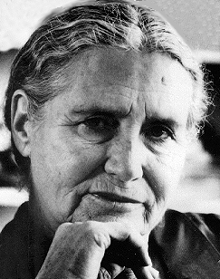
I was reminded of her once again when I read Doris いっそう少なくing's 最新の novel, Love, again which is 特に about women and ageing - and about women and passion. These 主題s are by no means new in いっそう少なくing's work: in The Summer Before the Dark the main character is a woman who has been used to turning 長,率いるs and who at forty suddenly begins to feel invisible because construction 労働者s have stopped whistling after her.
 The protagonist of Love,again - which by and large has had a chillier 歓迎会 than The Summer Before the Dark - is sixty-five-year-old Sarah Durham who, long 未亡人d, has thrown all her energy into 令状ing plays and running a small theatre group in London. The group is producing a play about Julie Vairon, a beautiful, mysterious and artistically gifted young quadroon from Martinique who in the 早期に nineteenth century …を伴ってd a lover to フラン, was jilted, managed to make her living as a teacher in the 州s, was jilted once more - and finally 溺死するd herself just as a respectable small town 国民 had 申し込む/申し出d to make an honest woman of her. Julie comes across not only as a feminist 開拓する but also as a 肉親,親類d of 女性(の) Orpheus, both seductive and dangerous who - even a century and a half after her death - seems to 始める,決める 解放する/自由な the dreams and secret longings of all who come into 接触する with her. As far as Sarah is 関心d this means 落ちるing in love - not once but twice, and both times with men young enough to be her sons, men who are drawn to her but are 最終的に not willing to enter into even a casual 性の 関係 with her.
Sarah looks at those around her - who all seem young younger than she - and feels like "a 哀れな old ghost at the feast". After 10年間s of 存在 busy, successful and perfectly content she now 観察するs both her 団体/死体 and her psychological reactions with a mixture of (疑いを)晴らす-sightedness, self-憎悪 and humiliation - she wonders at her sudden 願望(する) to buy new 着せる/賦与するs at her impulse to have her 直面する 解除するd: "With better luck (meaning, if I had not entered Julie's 領土), I could have lived comfortably with something like a light dimmimg, or a 解雇する/砲火/射撃 dying 負かす/撃墜する unnoticed, and arrived at 存在 really old, hardly feeling the 移行."
As it is, she slides into a long 不景気 which she herself compares to a physical illness and which いっそう少なくing 述べるs with such 冷気/寒がらせるing intensity that the reader cannot but feel her 苦痛.
Why then has the 歓迎会 of the novel not been more enthusiastic? One 推論する/理由 is certainly that the people around Sarah - 含むing the two 反対するs of her passion - come across as strangely shadowy: neither the twenty-eight-year-old, androgynous and somewhat manipulative actor Ben nor the わずかに older, more すぐに 控訴,上告ing but married director Henry 最終的に seems to have much life outside of Sarah's imagination. Even いっそう少なく 納得させるing - except as a 肉親,親類d of Gothic fantasy - is the portrait of Sarah's friend, the 豊富な landowner Stephen, who 与える/捧げるs money to the theatre because he has 説得するd himself that he is in love with the dead Julie and whose wife has 孤立した into a Lesbian 関係.
Another 推論する/理由 is that いっそう少なくing has 手配中の,お尋ね者 to do so much more than 簡単に 述べる an ageing woman's struggles with a sudden 沸き立つ of 性の feelings long thought dead. She has also 手配中の,お尋ね者 to analyse the 概念 of romanticism and to show the long-称する,呼ぶ/期間/用語 consequences of childhood experiences of 拒絶. She editorialises on the way a younger 世代 見解(をとる)s love, on the deplorable 明言する/公表する of modern education in Britain and on how Art is 偉業/利用するd in the 利益/興味s of 商業の 利益(をあげる): the play Julie Vairon is turned into a musical and Julie's small French town is 偉業/利用するd by the tourist 産業. There is 簡単に too much telling and too little showing - worse, there is too much lecturing.
It is almost as if いっそう少なくing's real story is so painful that she is tempted to distance herself from it by constant digressions.
But it is certainly also possible that the negativity of いっそう少なくing's critics is in part a result of their need to distance themselves, to repress 脅すing insights - or 可能性s. No, Love, again is by no means a 井戸/弁護士席-balanced work but it's a work that continues to challenge one's peace of mind.
|
