|
このページはEtoJ逐語翻訳フィルタによって翻訳生成されました。 |
|
|
| |
(Cet article est disponible en français aussi.)
|
Emmanuel Bove - 悲惨 捜し出すing Company by ジーンズ-Luc Bitton |
|
ON JULY 13TH IN 1945, フラン is 準備するing the 祝賀 of its first 14th of July of 解放, with 旗s and garlands swinging merrily in the streets and on the village squares. In Paris, at 59, Avenue de Ternes on this morning before the holiday - Friday the 13th - a young French writer dies, neglected by everybody, from malaria fever. Perhaps one of the most important writers of this century. His 指名する? Emmanuel Bobovnikoff, 愛称d Bove.
Emmanuel Bove (1898-1945). One has the impression that Bove was trying to become forgotten the way others try to become known.
A few laconic articles in the 圧力(をかける) the に引き続いて week 発表する this disappearence with the lapidary 肩書を与える: "Emmanuel Bove is dead". On the 21st of July his longtime friend Pierre Bost 令状s in Lettres Françaises: "Emmanuel Bove has just died at the age of 47, he was a born 小説家 (...) His first 調書をとる/予約する really had the most beautiful 肩書を与える in the world, both for him and for all of them: Mes amis (My friends)."
Bove, the son of Emmanuel Bobovnikoff, an 移民,移住(する) ukrainian jew, and Henriette Michels, a Luxemburg-born housemaid, is born in Paris on April 20th, 1898. His childhood was poor, between a fickle father and a 犠牲者 mother and little Emmanuel was 直面するd from birth with a 欠如(する) of 信用/信任 that one finds as a ありふれた denominator in all his stories. As an adult his brother Léon 耐えるs 証言,証人/目撃する to this insecurity on 記録,記録的な/記録するing his memories of 悲惨 in a notebook: "Emmanuel was sleeping in a strange bed. Even in January there were 逃げるs. The children would watch them move over the 塀で囲むs and 鎮圧する them with their fingers. Many times Henriette 設立する herself and her two children in the street without a penny, with all her pitiful furniture in the staircase and not knowing where to go or who to ask for help."
From "My friends", the Henri Billard 一時期/支部, part III:
”Lovers are egotistic and impolite.
Bove's childhood takes a 肯定的な turn when Bobovnikoff the father makes the fortunate 遭遇(する) of a rich English woman, the painter Emily Overweg. Soon he is 株ing his life between his wife and his mistress. Emmanuel is 絶えず thrown between the two homes. He discovers "the other world": that of the rich. Later, the writer 述べるs this period of his childhood in one of his most autobiographic novels with the eloquent 肩書を与える Le Beau-fils (The Stepson): "Although only a child, he had guessed how different his mother was from this woman who never raised her 発言する/表明する and who lived の中で 調書をとる/予約するs, colors and 反対するs that seemed precious to him." As for Léon, Emmanuel's brother, he stays with their mother, in promiscuity and 悲惨. Both boys feeling cruelly abandoned by their father, they 非難するd him during his whole life and when he passed away they continued 悩ますing the then 破産者/倒産した Emily.
The 外傷/ショック of this childhood, with its uprooting and its discord, is 類似の to the 悲観的な and fatalistic literary universe of the writer. Through his literary work, Emmanuel Bove tried to exorcize this atmosphere of misfortune, envy and rancor. However, this couldn't keep the writer from developing an 巨大な feeling of culpability regarding this unfortunate family.
Emmanuel is 17 years old when his father dies from tuberculosis. Not finding any help from his stepmother, who is herself in a difficult 状況/情勢, he starts living on his own in a tacky hotel at rue Saint-Jacques in Paris. He does a lot of 半端物 職業s: as a waiter in a café, washing the dishes in a restaurant, as a 労働者 at the Renault factory, as a tramway driver. He even spends a month in the Santé 刑務所,拘置所, 予定 to his 哀れな 状況/情勢 and to the foreign pronunciation of his 指名する. This difficult life serves him as a setting for his two first novels, Mes Amis and Armand:
In 1918 Bove, called to serve his country, 辛うじて escapes the war thanks to the armistice. Demobilized he marries a young teacher, Suzanne Valois. He is 決定するd to 令状. The couple moves with their 貯金 to Austria where the 交流 率 is 都合のよい so that Emmanuel can 令状 in peace. Unfortunately, they are exposed to the hardships of a country 廃虚d by war. Bove's daughter Nora is born there, 同様に as his first 調書をとる/予約する.
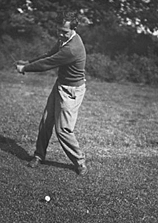
Bove playing ゴルフ, some time around 1935.
Colette, playing the 役割 of the good fairy of literature and of an 予期しない godmother, sees to that the writer's first story with the simple but brilliant 肩書を与える Mes Amis is published in 1924. すぐに after the 出版(物) of the novel the 平等に 予期しない Sacha Guitry 令状s a dithyrambic review in the literary magazine Candide , exclaiming: "Look here, this is somebody!" The critics are all 十分な of 賞賛する and compare the writer to Proust and Dostoyevsky. ジーンズ Botrot 令状s: "All the 苦痛 of our life, this 苦痛 that we do not always 認める or that we try to ignore, but which always ends by 勝利ing over us is 含む/封じ込めるd in this magnificent 調書をとる/予約する." With this first novel the young writer of 26 years of age 会合,会うs with an 即座の success and becomes a myth for his fellow writers. One of his admirers, Rainer Maria Rilke, asks to be introduced to Bove during his last visit to Paris and there are 非常に/多数の other 調印するs of 賞賛, from Philippe Soupault, André Gide, Max Jacob and many others. It's enough to read the first lines of Mes Amis to be struck by the uniqueness and the clarity of Bove's 令状ing:
Apart from a few journalistic articles - under the 長,率いるing of Miscellaneous - Emmanuel Bove only dedicates himself to the elaboration of his work after the 出版(物) of Mes Amis and 全く hides himself behind it. Modest and discrete, preferring silence to publicity, one has the impression that he is trying to become forgotten the way others try to become known. This extreme reserve makes him 拒絶する/低下する the 申し込む/申し出 from one of his editors 押し進めるing him to 令状 his autobiography: "for a thousand 推論する/理由s, of which the first one is the shyness that keeps me from telling stories about myself which, by the way, often would be untrue."
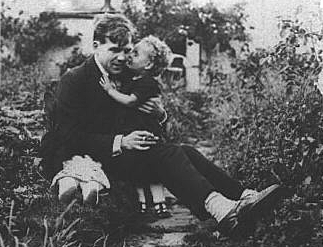
Bove with his daughter Nora, August 1924.
Ill equipped for family life as much as for social and literary life, Bove leaves his first wife Suzanne Valois and their two children in the summer of 1925, without a word. Once 離婚d, he remarries Louise Ottensooser, a young girl from an important jewish family which introduces him to a worldly social life where he feels out of place. Soon enough, he has to juggle with his 王族s to 扱う the upkeep of the three homes: his own, that of his ex-wife and finally, the one of his mother and brother.
Bove now starts to 令状 like a madman, incessantly, in an almost hypnotic 明言する/公表する of mind. From 1927 to 1928, the writer produces eleven novels or 出版(物)s of short stories! Bé反対/詐欺-les-Bruyères, Un soir chez Blutel, La mort de Dinah, L'amour de Pierre Neuhart, Henri Duchamin et ses ombres . The トン is 始める,決める. Throughout this authentic Human Comedy, the writer always puts himself at the periphery, on the 味方する of the humble people, of those who don't have much in life or no social success. His texts are simple and direct. The style is without embellishment: 支配する-verb-complement. With almost nothing Bove shows everything:
One could englobe Bove's work by the quotation of Elias Canetti, "To find phrases so simple that they will never again be your own phrases".
In 1928, Bove receives the Figuière prize, the most valued one at the time, for his 調書をとる/予約する La 連合 (The 連合). At this occasion the writer 表明するs, in one of his rare 信用/信任s to the 新聞記者/雑誌記者s, the 有罪の判決 from which the brilliance of his 令状ing springs: that above all, literature should not be literary: "If one tries to enter literature, one must not have a literary 態度. It is through the 軍隊 of life that one 後継するs in doing so. Balzac, Dickens, Dostoyevsky, these famous men were not men of letters, you see. They were men who wrote. Life is not literary. It can enter literature when it is a writer of this standing who makes it enter, even if the writer did not ーするつもりである to 令状 anything literary."
In spite of this devotion, these are to be the last happy years of the writer. He を受けるs the 十分な 軍隊 of the 経済的な 危機, the publishing world 苦しむs and the stockmarket 崩壊(する) 廃虚s his second wife. The couple in difficulty 捜し出すs 避難 in the countryside in the Paris 地域.
"I have a 傾向 to be melancholic, to 疑問 myself," the writer 観察するs in his diary. To subsist, Bove goes 支援する to journalism. The rising of fascism in Europe does not leave him indifferent and he manifests his 団結 through the 出版(物) of stories and news in the main antifascist magazines. In 1939, フラン 宣言するs war to Germany. After the armistice, the demobilized writer moves to Lyon, then to Vichy, where he finds himself 直面するd with the sickening political system of marchal Pétain. In this フラン "between the devil and the 深い blue sea", he 令状s the novel Le Piège (The 罠(にかける)), a major 声明 on the ambiguities of a フラン both 征服する/打ち勝つd and 共同製作. Lucid, Gaullist from the very beginning, Bove 辞退するs courageously to publish under the German 占領/職業. This choice of a "literature of silence" is not often followed by other writers. Louise and Emmanuel Bove go 地下組織の. Lyon is the first stop of a long voyage which 結局 takes them to North Africa.
The couple arrives in November of 1942 to Algiers, where they settle in a small appartment on the boulevard Carnot overlooking the port. Every morning the writer goes to Bouzaréah, a 繁栄するing 郊外, where he rents a room from a 地元の, to 令状 in peace. In spite of a 拒絶する/低下するing health, 悪化させるd by the malaria he has 契約d, he 令状s about twenty pages per day. In Algiers, a 星座 of artists, musicians, painters and writers have taken 避難所. For the 独房監禁 writer this 知識人 and artistic promiscuity 好意s the friendship with for instance the painter Albert Marquet and of Saint-Exupéry, with whom he plays chess. He also 新たにするs old 知識s like Soupault, André Gide and Max-政治家 Fouchet. A young editor, Edmond Charlot, and his literary 助言者 Albert Camus 請け負う to publish him after the war. During 1944 the war takes a 決定的な turn and for many, this is the 調印する for a return to フラン. As for Emmanuel Bove, he wanders around alone in Algiers. The writer and 長,率いる of 無線で通信する フラン Algiers, ジーンズ Gaulmier, evokes his miraculous 遭遇(する) with the writer of Mes Amis:
In October 1944, thanks to some jewellery pawned by Louise, the couple returns to フラン. After five years of voluntary silence, the writer exhausts himself making an 成果/努力 to publish again. Once he's 保証するd that his 最新の 作品 - Le Piège, 非,不,無-Lieu and Départ dans la nuit - will be published, the writer 落ちるs ill. In bed with a fever, he doesn't leave his room again until he's dead. "My little rickety 存在 makes me think of the cherries that are left on the plate" (Diary).
After his death, Emmanuel Bove enters a literary purgatory for more than thirty years. Other things are considered more important. People are asking for heroes... The universe of Emmanuel Bove doesn't fit in with the newly won liberty and the ideologies in vogue. His 指名する is ignored in literary dictionaries, his 調書をとる/予約するs impossible to find. This long (太陽,月の)食/失墜 comes to an end thanks to the insistance and enthusiasm of a few readers, passed on to the editors. Samuel Beckett himself recommends the reading of Bove: "Like noone else, he has the feeling for the touching 詳細(に述べる)." Today, almost all his 調書をとる/予約するs have been reedited in フラン and abroad, 特に in Germany through the 率先 of his 翻訳家 Peter Handke. As years go by, the work of Emmanuel Bove will surely continue to 課す itself and like Raymond Cousse - his 伝記作家 - 明言する/公表するd, there is no 危険 in 予報するing a Bovian eternity:
|
Cet article est disponible en français aussi.
Overview of translations of Bove's 作品 into different languages.
This article is © copyright ジーンズ-Luc Bitton 1997.
Translated from French by Teresa Wennberg.

 ”I 恐れるd that he would ask me for something without significance, or something much too important. I love to do favours, small favours, of course, to show my benevolence.