| |
WORKING WITH DEATH as a literary and poetical motif, and 特に 輪郭(を描く)ing how death permeates, darkens and 侵害する/違反するs people's lives - this is a 原則 which characterizes the writings of Austrian author Ingeborg Bachmann. As 早期に as in the poem "Dunkles zu sagen" (表明するing the Dark) she 令状s:
Wie Orpheus spiel ich
auf den Saiten des Lebens den Tod
und in die Schönheit der Erde
und deiner Augen, die den Himmel verwalten,
weiß ich nur Dunkles zu sagen.
(From "Die gestundete Zeit", 1953.)
She pondered alienation and 圧迫 in her poems and her prose, and also in 無線で通信する plays - a 演劇 form she had a very special, strong 関係 with. In a 草案 for an essay about Maria Callas, she 描写するs the オペラ singer as one of those who seem to live on the sharp 辛勝する/優位 of a かみそり. We often 会合,会う people with a 運命 like that in several of her own 作品.
 During the course of her life - born Klagenfurt 1926; died Rome 1973 - she published a 比較して small number of 作品. Two collections of poems, two 調書をとる/予約するs of short stories, a novel. その上に, essays, 無線で通信する plays, and libretti for two オペラs, "Der Prinz 出身の Homburg" and "Der junge Lord", composed by her friend Hans Werner Henze. During the course of her life - born Klagenfurt 1926; died Rome 1973 - she published a 比較して small number of 作品. Two collections of poems, two 調書をとる/予約するs of short stories, a novel. その上に, essays, 無線で通信する plays, and libretti for two オペラs, "Der Prinz 出身の Homburg" and "Der junge Lord", composed by her friend Hans Werner Henze.

”She was appalled and yet fascinated
by the fact that 罪,犯罪s against humans
are 存在 committed on such a large 規模
also outside of the war scene.”
It is no exaggeration to say that her fame stands 真っ先の with her poetry. Already in the 早期に 60's, she talked about an 切迫した reorientation of her 令状ing, に向かって prose. What impelled her was a wish to work with death as a motif and with reflections on the hidden 軍隊s of 暴力/激しさ and 圧迫 in society. She was appalled and yet fascinated by the fact that 罪,犯罪s against humans are 存在 committed on such a large 規模 also outside of the 境界s of war. "Since long have I pondered the question of where fascism has its origin. It is not born with the first 爆弾s, neither through the terror one can 述べる in every newspaper ... its origin lies in the relations between a man and a woman, and I have tried to say ... in this society there is war 永久的に." [1]
In interviews and in 関係 with reading soirées she talked about her work in 進歩, with these 主題s in different variations, where death is used as a metaphor 描写するing how humans are 侵害する/違反するd both within the 私的な sphere and on the more overarching social level. When she died she left behind a collection of 草案s, 含む/封じ込めるing appr. 10,000 pages - half of it is part of this 事業/計画(する). The manuscripts have been published, with a 肩書を与える often used by Ingeborg Bachmann herself: "'Todesarten' - Projekt" (Piper Verlag 1995, ed. Monika Albrecht, Dirk Göttsche). The five 容積/容量s 含む/封じ込める very fragmentary sketches 同様に as 完全にするd stories. Only in three instances were these 作品 現実に published. The novel "Malina", which was her first 調書をとる/予約する of the genre, was published in 1971, and the に引き続いて year (機の)カム the story collection "Simultan". This circle of 作品 also 含むs a speech she wrote when she received the Georg Büchner prize in 1964, and it was published in 調書をとる/予約する form the year after, with 製図/抽選s by Günther Grass. の中で other things, the speech "Ein Ort für Zufälle" is also a meditation upon the city of Berlin.
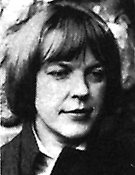
Ingeborg Bachmann (1926-1973)
The 残り/休憩(する) is unfinished 構成要素, but the 広範囲にわたる commentary explains her enormously wide-spanning conceptual universe, packed with emotions, the relations between the different narrative fragments, and not least, all of the echoes from other authors' writings, which she wove into the fabric of her prose.
Through the years she realized more and more that her idea was growing into a whole family of 作品, consisting of novels 同様に as stories, often with essayistic elements. Characters from the background in one story could re-appear in the foreground of another. She 設立する inspiration and 指導/手引 in 栄誉(を受ける)é de Balzac's 控訴 of novels "La comedie humaine", but 平等に important was "Der Mann ohne Eigenschaften" by her fellow 同国人 Robert Musil - 特に regarding the combination of psychological portraits of individuals and essayistic, 批判的な 熟考する/考慮するs of civilization and society.
Ingeborg Bachmann used the 肩書を与える "Todesarten" for the first time in 関係 with a novel she began 令状ing in 1962 - but it is built upon older 構成要素 and 現実に 起こる/始まるd in the 早期に 50's. In both 見解/翻訳/版s a man by the 指名する Eugen is the central character. In the later 見解/翻訳/版 Eugen Tobai is a rationally thinking scientist, an assistent at the University of Vienna, where he is 占領するd with history, psychology, and sociology. He sees himself as a seismograph, 登録(する)ing 苦悩 and pathological 条件s of society. But his anguish is also rooted on a 私的な level, he is tormented by bad dreams and attacks of 苦悩. He senses 脅しs all around, he 恐れるs road 事故s or other 状況/情勢s of which he has no 支配(する)/統制する. He does not, however, perceive this as the hazard of 存在 caught in 事故s in the normal sense: he is afflicted by nightmares about how he is 存在 killed, though by 匿名の/不明の 軍隊s.
"Todesarten" was the 肩書を与える also for a novel Bachmann started on later, which was published posthumously as "Der 落ちる Franza." In this 草案, an important 転換 is already taking place, since in earlier 作品 mostly men have 占領するd the narrative 中心, as in the story collection "Das dreissigste Jahr". But from the middle 60's on, she 焦点(を合わせる)d on the lifestories of women instead: characters (打撃,刑罰などを)与えるd with 孤立/分離, betrayal, or - to borrow a frequently used 表現 - by "mental 殺人".
Franza lives in Vienna, married to a psychiatrist 指名するd Jordan, who is a 冷淡な but successful scientist, and he relates with his wife through his satanically controlled 熟考する/考慮する of her 増加するing mental illness. To escape this hell, she runs away to the area of her childhood, where she stays with her brother. Together they travel to Egypt - the account here is probably very much 影響(力)d by the author's own 旅行 to the Arab world.
The change of scenery, from the landscape of the big city to that of the 砂漠, is playing an important part also in the earlier について言及するd speech "Ein Ort fur Zufälle". Superimposed on this motif are a lot of overtones, for instance the glaring contrast between the Western world and other cultural 環境s. But she also alludes to political history: memories of 植民地主義, as a part of European culture, the notion of higher and lower races. A quotation from Rimbaud ("Je suis d'une race inférieure") links the unscrupulous 開発/利用 of one group of people by another, with 悲劇s taking place on individual, 私的な levels; love 事件/事情/状勢s for instance, where one party ruthlessly breaks the other party 負かす/撃墜する.
This 肉親,親類d of polyphony, where grand motifs of civilizational critique is mirrored in the 熟考する/考慮する of intimate 悲劇s, is の中で the most poignant 面s of the whole "Todesarten" 控訴, although so few of its parts were 完全にするd. One of the 推論する/理由s why the Franza novel was also put aside, was that Ingeborg Bachmann felt 相当な 不満 with the form of it. She discerned 緊張 within the 構成要素, which called for an even wider 範囲. The conception of "Todesarten" was transformed from the 計画(する) for a separate novel to a larger cyclical work. She later explained the meaning of the 肩書を与える: " ... For me, if I can appraise my own 計画(する)s, it means to create a 要約 with all of the 罪,犯罪s 存在 committed during our time."
In the 落ちる of 1966 she starts on the most 集中的な 段階 of her work. She 令状s 同時に on a whole 一連の narratives. One of them, a large novel, in this editon called "Goldmann/Rottwitz-Roman", the 指名するs of two families. In another 事業/計画(する) she collects stories about women in Vienna; parts of the 構成要素 in this planned 容積/容量 ("Wienerinnen") 設立する its final form in the story 容積/容量 "Simultan". Futhermore, she started working on the novel, which in its 完全にするd 形態/調整 was 現在のd as an 予備交渉 for the whole 控訴 "Todesarten". This novel is called "Malina". The reactions, when it was published, were very disparate - 期待s had been eager, as she had not published anything for several years. 確かな critics showed 広大な/多数の/重要な 利益/興味, not to say delight - other reviewers were 事実上 拒絶するing.
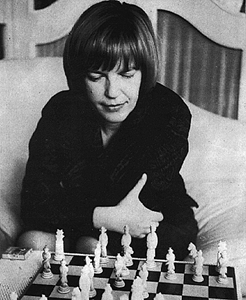
Ingeborg Bachmann wrote about the philosophy of ツバメ Heidegger in her doctor's dissertation. Like many other authors she tried to reconquer the German language again after the Nazi dishonor of it.
The woman who accounts for her life does it in the form of monologues, which on one 手渡す are intellectually 激烈な/緊急の and emotionally 告発(する),告訴(する)/料金d - on the other 手渡す they appear dreamlike, a subconscious flow. The author's 利益/興味 in writers like James Joyce and Samuel Beckett meant a lot when it comes to technique and characterization, but she had also learnt from philosophers like Ludwig Wittgenstein and ツバメ Heidegger (her dissertation was about Heidegger). Like several of the other novels, "Malina" is divided into three parts. The first is called "Ich", it is 中心d around the self. A woman of 知識人 background lives in Vienna, and her love 事件/事情/状勢 with the Hungarian Ivan takes place 完全に on his 条件. He lives with his wife and two children in the の近くに proximity to the flat where the narrative "I" lives. Her time passes under the 調印する of waiting: yearning for his calls, 任命するing 未来 会合s. Time after time she lights her cigarettes, nothing moves in her desolate room, except maybe the coiling smoke.
But there is yet another man in her life. He is the Malina who lent his 指名する to the novel. The conversations with him いつかs lead to 救済, but as often to despair, the dreamlike character of these 対話s 許すs for the reader to more and more 嫌疑者,容疑者/疑う that Malina dwells within herself, a male antithesis of her personality. On another level Ingeborg Bachmann 陳列する,発揮するs her sense for polyphonic narrative technique, the interplay of descriptions of everyday life, everyday people and the presence of dreamed 人物/姿/数字s in this sphere, who 所有する strength to go beyond the 国境. This play between reality and hallucination is 強めるd in one part of the novel, "Der dritte Mann". She uses Graham Greene's and Carol Reed's 肩書を与える from the film "The third man", which takes place in Vienna, where the 語り手's memories of 暴力/激しさ in the past are 描写するd.
”The woman receives three 石/投石するs
with inscriptions. The first reads
’Live and be amazed!’, the second,
’To 令状 is to be amazed!’.”
The third man, after Ivan and Malina, is a father 人物/姿/数字 appearing with dream images of death all around him: church yards, gas 議会s, 強姦 scenes - a whole collage of 残虐(行為)s. During this dream 小旅行する an almost mythological approach is used to 述べる how the woman receives three 石/投石するs with inscriptions. The first reads "Live and be amazed!", the second, "To 令状 is to be amazed!" The third inscription is illegible and is not 明らかにする/漏らすd until we reach the last part of the novel. The message is "Kill your beloved!". This phrase 影響する/感情s the course of events 権利 up to the very last 宣告,判決. Ivan leaves the woman, Malina's 支配(する)/統制する gets stronger, her self-信用/信任 弱めるs and the last line of this tale is inexorable: "It was 殺人."
The publishing of "'Todesarten'-Projekt" 陳列する,発揮するs a maze of 草案s, re-令状s, unfinished and finished 作品 of art. The intensity of a most personal 発言する/表明する is indescribable, anyone 開始 one of the 容積/容量s to read will sense it すぐに. Ingeborg Bachmann's 力/強力にする to give life to characters and to 形態/調整 her language, also with the help of rich literary and philosophical sources, is intellectually impressive, but it also 影響する/感情s us since the use of it is always emotionally 動機づけるd. It is also striking how many other art forms, besides poetry and literature, that (不足などを)補う her associative universe. Time and again, musical 言及/関連s find their way into her play with death. "Malina" echoes phrases from Richard Wagners "Tristan und Isolde", the musical 演劇 where the lovers escape the 支配するs and 規則s of the real world and 迎える/歓迎する death as the true life form - the grand love duet of the second 行為/法令/行動する. The 熟考する/考慮する in the novel of the 解散 of 身元 and how the ego is 崩壊するd, also 含むs a piece by the Viennese Arnold Schönberg in its web of quotations and allusions. The Schönberg melodrama "Pierrot lunaire" is について言及するd several times, not least the exclamation "O alter Duft aus Märchenzeit". [2] One similarity may be 述べるd thus; in the same way as the woman in "Malina" breaks 負かす/撃墜する 予定 to an antithesis in her own personality, so also does Schönberg 描写する how a 哀れな man (解釈する/通訳するd by a 女性(の) soloist using "sprechstimme") is torn apart between 願望(する) and despair.
Music was a part of Ingeborg Bachmann's life in many ways. Her 利益/興味 in Maria Callas has been について言及するd, and also her 共同 with 作曲家 Henze. For him she wrote the poem "Enigma", which ends:
Du sollst ja nicht weinen,
sagt eine Musik.
Sonst
sagt
niemand
etwas.
(You shall not weep
says one music
さもなければ
nobody
says
anything)
Her narrative art in "Todesarten", with its musicality and polyphony, seems on the other 手渡す to be built upon 涙/ほころびs from beginning to end. A requiem, not for the dead, for those on the other 味方する of life's 国境, but for those 軍隊d to live on, 苦しむing constant deadly 違反s.
Ingeborg Bachmann died in the 落ちる of 1973, a consequence of a 解雇する/砲火/射撃 in her appartment in Rome. The circumstances behind this 解雇する/砲火/射撃 have remained a mystery. She is buried in her native town of Klagenfurt in Austria.
公式文書,認めるs:
1. "Ich habe schon vorher darüber nachgedacht, wo fängt der Faschismus an. Er fängt nicht an mit den ersten Bomben, die geworfen werden, er fängt nicht an mit dem Terror, über den man schreiben kann, in jeder Zeitung. Er fängt an , in den Beziehungen zwischen einem Mann und einer Frau, und ich habe versucht zu sagen ... hier in dieser Gesellschaft ist immer Krieg." (引用するd in "Über Ingeborg Bachmann, Igel-Verlag, Paderborn, 1994) [Go 支援する]
2. "Oh, 古代の scent from times of fairy-tales" [Go 支援する]
|
